Oct, 29, 2026
A 100 W LED flood light on a 6 m pole is often asked to light a car park, a loading yard and the back of a warehouse with one aim. On paper it looks simple: the catalogue line says 100 W and 13,000 lumens, so the job is treated as done. The three numbers that actually decide whether the installation works are usually missing from that line: beam angle, ingress protection and driver quality.
Get those three right and wattage becomes a straightforward calculation. Get them wrong and no amount of extra power will fix a dark corner, a wall of glare, or a fixture half full of condensation after its first winter. What follows is the order of decisions that experienced buyers use for outdoor LED flood lighting, along with the tolerances and test documents worth requesting before a purchase order is signed.
Content
Beam angle is the most misread specification in outdoor lighting. A 100 W fixture with a 60 degree beam produces roughly four times the peak intensity of an identical 100 W fixture with a 120 degree beam, because the same lumen output is concentrated into a quarter of the area. That is why two lamps with the same wattage can perform completely differently on site.
Distribution shape matters as much as the number. A symmetric flood spreads light in a circle and wastes a large share of it outside the target area. Asymmetric Type II, III and IV distributions push light forward and sideways, which raises useful illuminance while cutting glare and light trespass. On projects near housing, that difference often decides whether an installation is accepted without complaint.
The optic behind the beam is either a reflector or a lens. Lens-based LED modules give tighter control and repeatable photometry from unit to unit, which matters when 200 fixtures have to look identical. Buyers who need a specific distribution should ask what optic is used and request the IES or LDT photometric file instead of trusting a beam angle printed in a brochure. A short explanation of what an LED module is is a useful starting point if the term is new.
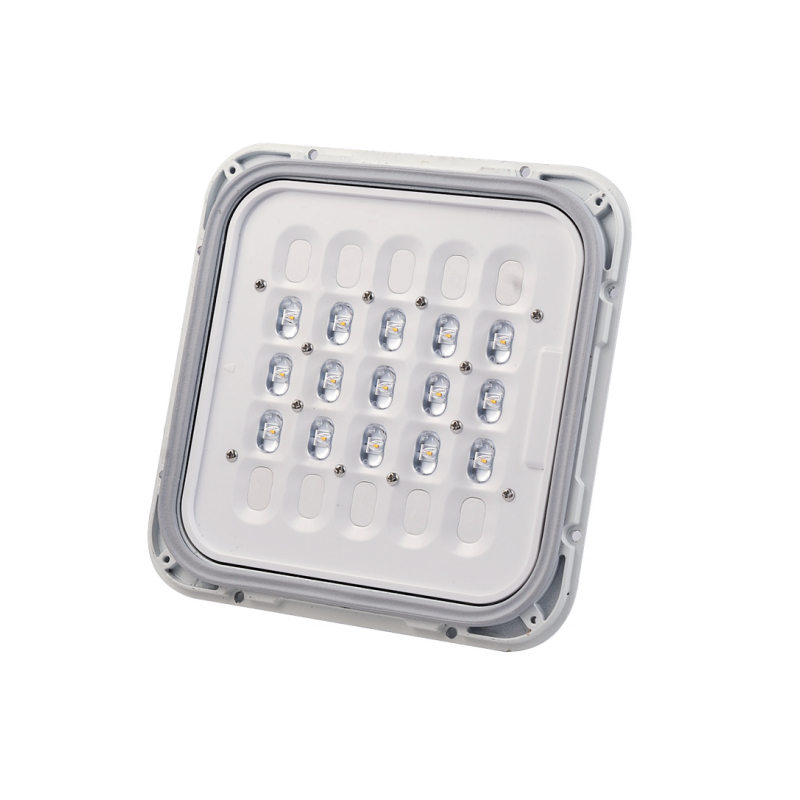 YM6701 Customized LED Module with Lens for Outdoor FixturesLens-based aluminium LED module for street and floodlight upgrades, offered in 16-, 20-, and 24-LED versions with IP65 and IK08 ratings.View Product →
IP65 means protection against water jets, IP66 against powerful water jets, and IP67 adds temporary immersion. For most outdoor flood lighting, IP66 is the practical target, because wind-driven rain arrives at pressure and at an angle rather than as a gentle vertical spray. Coastal and industrial sites add salt and dust, and washdown areas add a hose.
The rating, however, describes a new and correctly assembled sample. Field failures usually come from three places:
Impact resistance deserves equal attention. IK08 or IK10 ratings matter for fixtures at vehicle height, on poles beside loading bays, or in public spaces. On coastal installations, ask for the salt spray test duration and the coating specification; a 500 hour salt spray result is a reasonable benchmark for hardware exposed to sea air.
Wattage is an input, not a result. Start from the illuminance and uniformity the site needs, then work backwards. The table below gives practical starting points for symmetric outdoor LED flood lights; final values depend on aiming, surface reflectance and the lighting standard that applies to the project.
| Mounting height | Typical wattage | Beam angle | Target illuminance | Common application |
|---|---|---|---|---|
| 3 to 4 m | 30 to 50 W | 100 to 120 degrees | 30 to 50 lux | Driveways, entrances, signage |
| 5 to 6 m | 50 to 100 W | 60 to 90 degrees | 50 to 100 lux | Car parks, yards, loading areas |
| 8 to 10 m | 100 to 200 W | 40 to 60 degrees | 50 to 75 lux | Perimeter lighting, practice courts |
| 10 to 12 m | 200 to 300 W | 25 to 40 degrees | 75 to 100 lux | Industrial yards, large hardstand |
Two rules keep the calculation honest. First, not all lumens reach the ground: a utilisation factor of 0.6 to 0.8 is realistic for a well-aimed fixture, so a 13,000 lumen lamp may deliver 8,000 to 10,000 lumens to the task area. Second, uniformity matters more than the average. A car park lit to 50 lux average with a minimum of 8 lux feels unsafe, while a site at 30 lux average with a minimum of 20 lux reads as bright and even. A minimum to average ratio of at least 0.25 is a common working target.
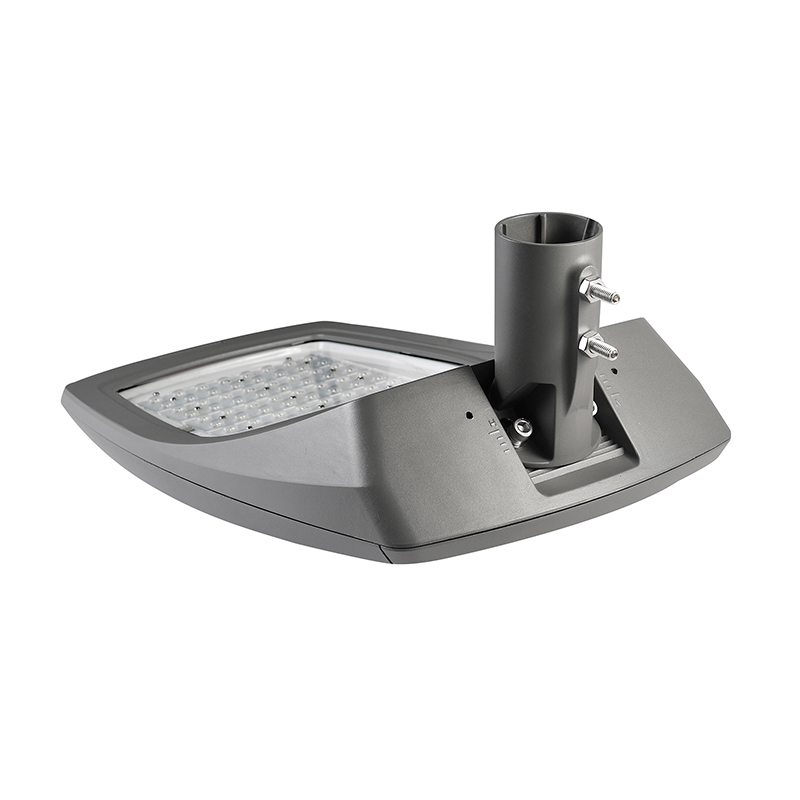 YMLED-6408L High-Brightness LED Street Light for Road LightingIntegrated die-cast aluminium street luminaire with tempered glass, precise light distribution and multiple Galaxy max outputs for road lighting uniformity and heat management.View Product →
An LED rarely fails from being switched on and off; it fails from heat and from the electronics feeding it. The housing is the heatsink, so die-cast aluminium with a real thermal path from the LED board to the fins is not cosmetic. A tempered glass cover with high light transmission also protects the optic from UV and scratching far better than most plastics, which matters on fixtures facing the sun all day.
The driver is roughly a tenth of the bill of materials and causes most warranty claims. Worth verifying before purchase:
A 50,000 hour rating is a statistical projection, not a promise about a specific unit. The driver warranty, the availability of spare drivers, and whether the LED module can be replaced separately are the terms that genuinely protect the investment over a ten year cycle.
Outdoor flood lighting is usually switched by time, daylight or movement. A NEMA or Zhaga socket on top of the fixture lets a photocell or a control node be added later without rewiring, which costs little at the factory and saves a great deal on site. Standalone photocells are cheaper but drift with dirt and age. Motion sensors suit car parks and yards where full output is needed only for a few minutes at a time, and they typically cut energy use by 30 to 60 percent in low traffic areas.
Solar is not a smaller version of a mains fixture; it is an energy budget. The panel has to recharge the battery while also running the light, and the battery has to carry the load through two or three cloudy days. In practice the useful output is decided by panel watts, battery watt hours and the controller, not by the nominal lamp wattage. A 100 W solar flood light that dims to 30 percent after four hours is often a 30 W fixture in disguise.
Check the autonomy figure in days, the battery chemistry and cycle life, whether the controller uses maximum power point tracking, and how the system performs in the lowest sunlight month rather than on the annual average. Integrated units that combine panel, battery and light in one housing are easier to install and harder to steal; split systems allow a larger panel to be aimed at the sun while the light aims at the ground.
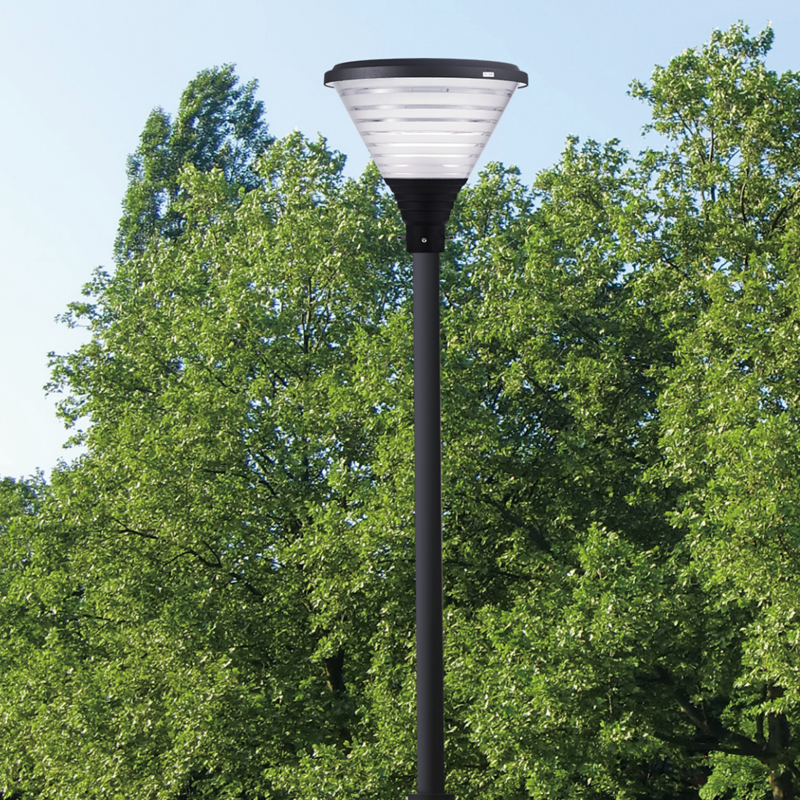 YMLED-6804 Integrated Solar LED Street LightAll-in-one solar street light combining panel, battery and LED module, with grid interface, IP65 protection and optional smart controls for outdoor roadway installations.View Product →
When the supplier is overseas, the documents matter as much as the sample. Ask for the IES photometric file, the LM-79 report, the IP test report, the driver datasheet with the surge rating stated, the IK rating, and the warranty terms in writing, including who pays freight on a claim. Confirm the certification position for the destination market; CE marking, for example, appears on specific product lines rather than across a whole catalogue, so it should be confirmed model by model.
Commercial terms deserve the same attention: minimum order quantity, whether colour temperature, branding or cable length can be customised, lead time in both low and high season, and how the fixtures are packed for sea freight. Glass-covered luminaires need foam or moulded inserts, and a container of loose cartons is an expensive way to learn that lesson. For buyers who want to understand the factory behind the quotation, the production background and export record are set out in the manufacturer profile.
Buy outdoor LED flood lights in the order the physics demands: distribution first, sealing second, driver and thermal design third, and wattage last. A fixture that aims light where it is needed, keeps water out and runs its driver cool will outperform a higher wattage unit on every measure a site manager cares about. Everything else, from control sockets to solar options, is a decision about how the installation will be operated and maintained over the next decade.
Related Products
 Private Industrial Park, Liangnong Town, Yuyao City, Ningbo City, Zhejiang Province, China
 +86-13486062091
 +86-574-2222 2345
 +86-574-2267 2345
 info@ym-lighting.com


 English
 中文简体