Oct, 23, 2026
Two pallets of 8 m conical poles arrive on site with 76 mm tenons, while the road luminaires in the same container were built with 60 mm slip fitters. Nothing is defective. The order simply treated the cross arm as a spare part instead of an interface. On any street, park or car park lighting project, the lamp post cross arm fixes the mounting height, the setback of the light from the pole, the wind load path into the foundation, and whether the luminaire can be fitted at all.
Content
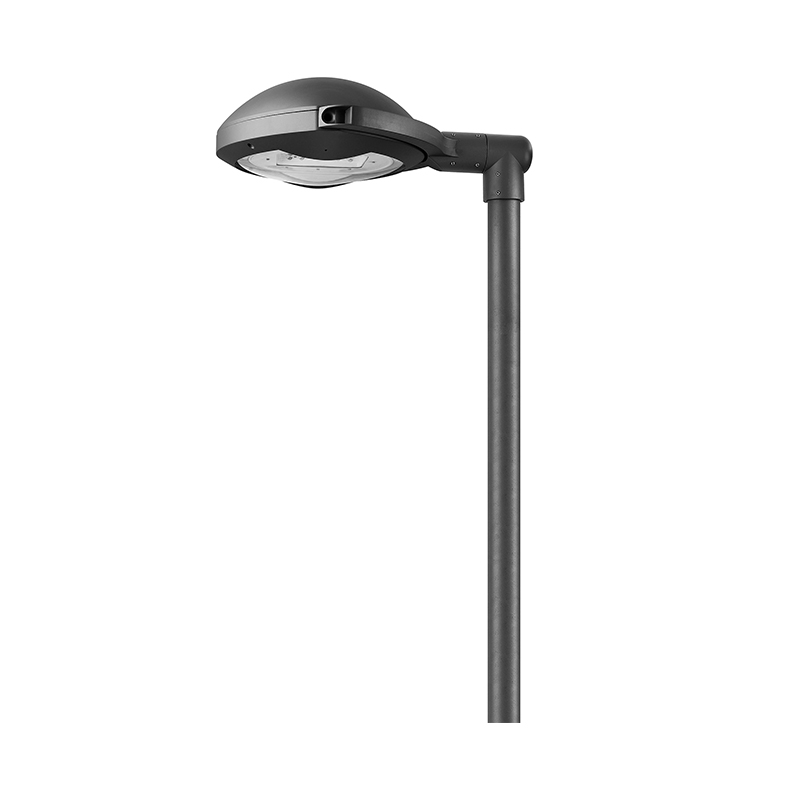
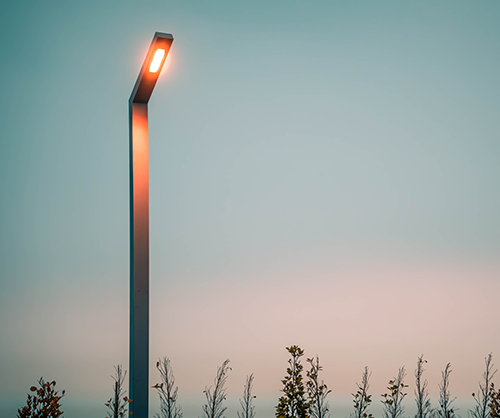
A cross arm, also written crossarm and often called a bracket arm, davit arm or mast arm, is the horizontal member that carries the luminaire away from the pole shaft. On a residential street it may be a 0.6 m straight tube bolted to the shaft. On a trunk road it can be a 2.5 m curved davit welded to a reinforcement collar. It fixes four things at once: mounting height, setback, lamp aim and the transfer of wind and dead load into the pole.
Two joints matter, arm to pole and arm to luminaire. Most warranty disputes on outdoor lighting start at one of them rather than inside the LED module.
Nearly every outdoor lighting layout is served by one of five configurations. The choice is a question of road class, pole height and how much load the pole top can carry, not of appearance.
| Arm type | Typical outreach | Typical mounting height | Where it works best | What to watch |
|---|---|---|---|---|
| Straight single arm, bolted bracket | 0.6 to 1.2 m | 4 to 8 m | Residential streets, car parks, footpaths | Flat plates seat badly on tapered poles, so slotted holes are needed for aiming |
| Curved davit arm, one piece | 1.0 to 2.5 m | 6 to 12 m | Arterial and distributor roads | Long spans need 4 or 5 mm wall tube and a properly sized weld collar |
| Double opposing arms, 180 degrees | 0.8 to 2.0 m per side | 8 to 12 m | Central medians and dual carriageways | Uneven luminaire weights twist the pole top before bolts are torqued |
| Three or four way cluster arms | 0.5 to 1.0 m per side | 6 to 12 m | Roundabouts, junctions, square lighting | Wiring congestion inside the shaft and undersized cable entry holes |
| Post top adaptor on an arm | 0.3 to 0.6 m | 3 to 5 m | Parks, plazas, pedestrian zones | Adaptor threads differ, and a 60 mm tenon is not a threaded nipple |
In practice the arm is rarely bought alone. It is ordered with the pole as one assembly, which is why the pole drawing should carry arm span, rise, tenon size and finish in a single table.
Agree on these seven values before discussing finish or price. They cause more delivery problems than any other part of the specification.
Write the tenon size on the purchase order as well as the drawing. Buyers who quote only luminaire wattage are the ones who receive a 76 mm tenon against a 60 mm fitter.
Steel remains the default because it is weldable, stiff and inexpensive. Q235B and Q355B are the grades that appear most often on export orders from China, but in most climates the finish matters more than the grade.
Hot dip galvanizing to ISO 1461 gives an average coating of 70 microns on steel between 3 and 6 mm thick, with a minimum local reading of 55 microns. ASTM A123 calls for an average of 86 microns on members 3.2 mm and thicker. Where color is required, polyester powder goes over the galvanizing at 60 to 100 microns and is normally tested to 500 or 1000 hours of salt spray. Two production details get missed repeatedly: galvanizing adds roughly 70 to 100 microns per surface, so holes and tapped threads need allowance or re-tapping, and slag or pinholes left in a weld become coating defects that show up as rust streaks two winters later.
 Pola PA Series Hot-Dip Galvanized Round Pole LightPA-series round steel pole for road and street lighting, with hot-dip galvanizing and powder coating for long-term outdoor use.View Product →
Buying pole, arm and luminaire from one factory removes the most common failure mode, because the tenon and the slip fitter can be checked against each other before packing. Yuyao Yangming Lighting, a Ningbo area maker of light poles and outdoor luminaires since 2001, sets out its own production floor, testing and export record on its company background page.
Cross arm design is mostly a fatigue and connection problem, not a strength problem. At a design wind speed of 40 m/s the dynamic pressure is roughly 980 pascals. A 60 W road luminaire with an effective projected area of 0.1 square meter and a drag coefficient near 1.2 pulls about 118 newtons, or 12 kg of force, at the end of the arm. Add its own weight of around 6 kg, and a 1.5 m arm generates a bending moment at the pole face in the region of 270 Nm.
That moment is modest for a 4 mm tube. The real risk sits in three places.
Short, thin arms in gusty or coastal locations are also prone to vortex shedding, the low hum that becomes a looseness complaint. A thicker wall or a small damper costs far less than a return visit.
An arm that is strong and well galvanized can still fail to work with the chosen luminaire. Check three interfaces before ordering.
Slip fitter luminaires slide onto the tenon and lock with two or four setscrews. Direct mount luminaires bolt to a flat bracket plate. Mixing both systems inside one project creates two spare part lines and two installation routines.
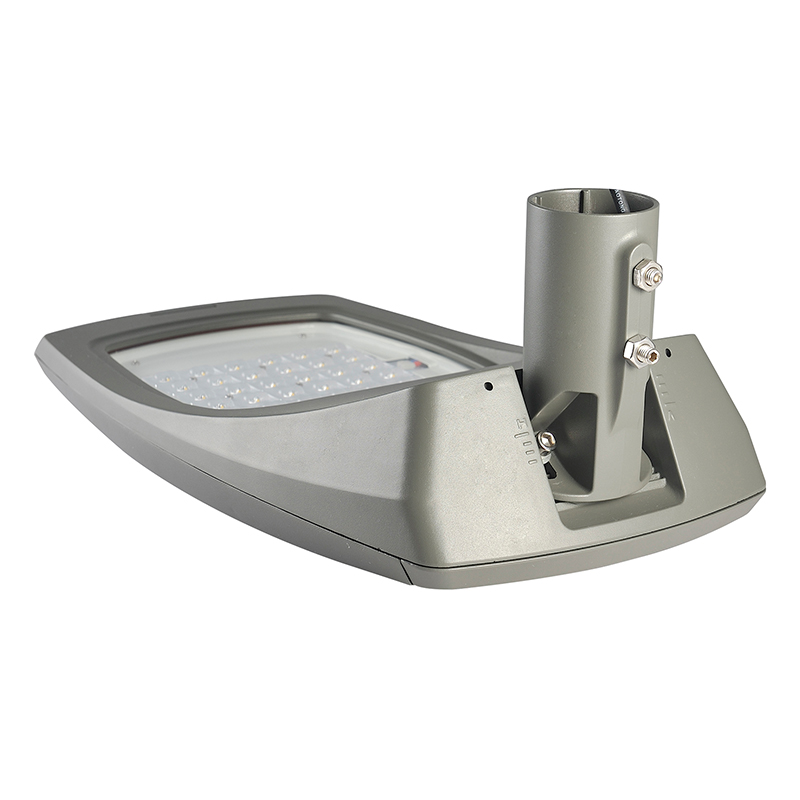 YMLED-6408M Waterproof Outdoor LED Street LightCost-effective outdoor LED street light for side roads and pathways, with optional NEMA/Zhaga sockets and dimming for smart-lighting upgrades.View Product →
NEMA and Zhaga sockets usually sit on top of the housing. A davit arm that curves over the housing can block access to the socket or the photocell, so check the drawing with the luminaire fitted.
A luminaire tested to IP66 on a bench is not automatically IP66 once it sits on a tenon. If the setscrew hole is left open, or the cable gland faces upward, water finds its way in. Specify a gasket or sealing washer at the joint and route the cable through the shaft into the base compartment.
Cross arms and pole brackets are simple enough to inspect at goods in. A caliper, a straight edge and a coating gauge will catch nearly every problem that matters.
| Item | Typical value or tolerance | How to check |
|---|---|---|
| Tenon outside diameter | 0.5 mm either way | Caliper, two axes |
| Bolt hole spacing | 1.5 mm either way | Template or caliper |
| Arm straightness | 1.5 mm per 1000 mm | Straight edge or jig |
| Arm to pole angle | 1 degree either way | Protractor or assembly fixture |
| Galvanizing thickness | 70 microns average to ISO 1461 | Magnetic gauge, five readings per part |
| Powder coat thickness | 60 to 100 microns | Coating gauge |
| Weld quality | No undercut, no porosity | Visual check, dye penetrant on samples |
Ask for the paperwork as well: steel mill certificates, a galvanizing thickness report, a salt spray report for powder coated parts and packing photographs. On a first order, a trial assembly of one pole, one arm and one luminaire before shipment is worth more than any document.
Once the layout is fixed, one page is enough. List pole height and taper, arm type, outreach and rise, tenon diameter and length, wall thickness, finish, design wind speed, luminaire model and quantity. Add the bolt pattern if the arm bolts directly to the shaft, and note whether the project needs one color across all poles and arms.
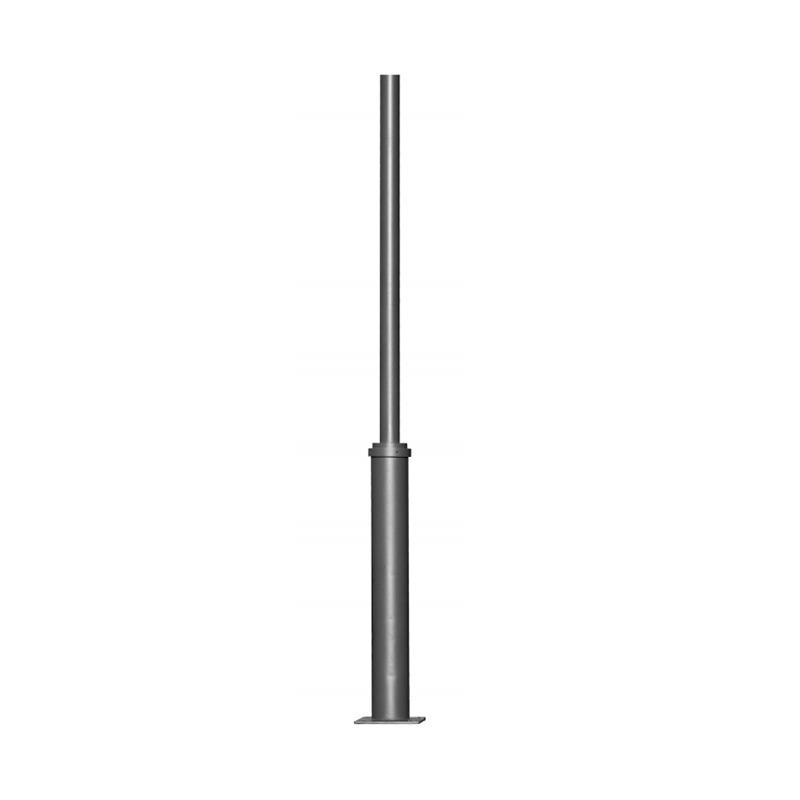 Pola PB Series Hot-Dip Galvanized Pole LightCustomized post-top outdoor pole for PB1/PB2 models from 3 to 4 m, with hot-dip galvanizing and coating for matched arm and luminaire layouts.View Product →
Keep tenon sizes consistent across a project. If two road classes genuinely need different tenons, order arms and luminaires as matched pairs so the spare parts list stays short. Current pole and luminaire documents are available on the downloads page if you want to compare dimensions before sending a request.
Adaptor sleeves exist, but each one adds a joint that must be sealed and tightened in the air. On a new project it is cheaper and safer to order the luminaire with the matching fitter, or the pole with the matching tenon.
At 70 microns average, hot dip galvanizing to ISO 1461 typically keeps a steel arm in service for decades in rural and suburban atmospheres. Coastal salt spray and industrial sulphur consume zinc faster, so heavier coatings or powder over galvanizing are worth the extra cost there.
Only when the lantern must sit away from the shaft, for example on a pole that also carries banners. A direct post top mount is simpler, cheaper and gives a cleaner silhouette in parks and plazas.
The lamp post cross arm looks like a length of tube with a bracket on the end. In reality it is the interface between the pole structure, the luminaire optics and the installer working day. Settle tenon size, outreach, rise, wall thickness and finish at the drawing stage, confirm them with a trial assembly, and the rest of the lighting package will fit together the first time it is unpacked on site.
Related Products
 Private Industrial Park, Liangnong Town, Yuyao City, Ningbo City, Zhejiang Province, China
 +86-13486062091
 +86-574-2222 2345
 +86-574-2267 2345
 info@ym-lighting.com


 English
 中文简体