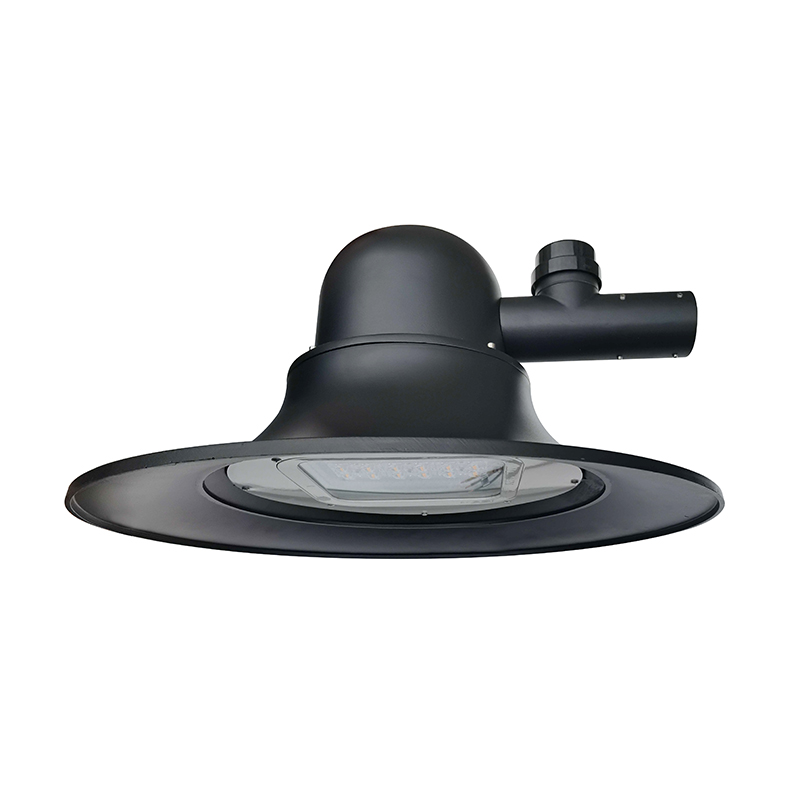
Oct, 22, 2026
A landscape specification arrives with one line that decides your fixture count: maintain an average of 1 footcandle along a 400-foot park walkway. Whether that means 14 bollards or 40 depends on four numbers, the delivered lumens of the fixture, the square footage you are lighting, the coefficient of utilization, and the light loss factor. Get those right and footcandle math becomes simple arithmetic, then sanity-checked against spacing.
The short version: average footcandles tell you whether a design has enough total light. Spacing, mounting height and beam distribution tell you whether that light lands where people walk. The first calculation takes five minutes. The second separates a layout that passes a footcandle check from one that looks right at night.
Content
A footcandle is one lumen falling on one square foot of surface. That definition matters because footcandles describe light arriving at a surface, not light leaving a fixture. A 3,000-lumen bollard does not deliver 3,000 footcandles to anything. It delivers a fraction of that, spread across the ground around it.
The lumen method connects the two:
Average footcandles = (delivered lumens per fixture x number of fixtures x CU x LLF) / area in square feet
Run the numbers on the walkway. At 300 feet long by 8 feet wide, the area is 2,400 square feet. A target of 0.8 footcandles requires 1,920 lumens on the ground. A bollard with 1,500 delivered lumens, a CU of 0.6 and an LLF of 0.85 contributes 765 effective lumens, so the average calculation asks for three fixtures. Three fixtures over 300 feet means 100-foot spacing, and a three-foot bollard cannot throw usable light 50 feet in every direction. The realistic layout needs roughly 15 to 20 units at 15 to 20-foot spacing. The average footcandle figure was never the binding constraint. Uniformity was.
Metric specifications are common on export projects, and the conversion is fixed. One footcandle equals 10.764 lux, and one lux equals 0.0929 footcandles. Divide lux by 10.764 to obtain footcandles, or multiply footcandles by 10.764 to obtain lux.
| Footcandles | Lux | Typical reference |
|---|---|---|
| 0.2 | 2.2 | Minimum ambient at a path edge |
| 0.5 | 5.4 | Residential path, low activity parking |
| 1.0 | 10.8 | Park walkway, garden path |
| 2.0 | 21.5 | Retail parking, building entrance |
| 5.0 | 53.8 | Facade accent, active plaza |
| 10.0 | 107.6 | High activity exterior task area |
Photometric files often report intensity in candela instead of illuminance. A fixture rated at 500 candela aimed straight down from a 10-foot mounting height produces 500 divided by 100, which is 5 footcandles directly beneath the head. Move the same fixture to a 20-foot pole and the value falls to 1.25 footcandles, because illuminance drops with the square of the distance. For points off the axis, apply the cosine correction: intensity multiplied by the cosine of the angle, divided by distance squared.
| Application | Common target (fc) | Notes |
|---|---|---|
| Garden and lawn borders | 0.2 to 0.5 | Decorative accent only |
| Park and residential walkway | 0.5 to 1.0 | Uniformity matters more than average |
| Low activity parking | 0.5 to 1.0 | Security and wayfinding |
| Retail and high activity parking | 2.0 to 5.0 | Pedestrian conflict zones |
| Residential street | 0.4 to 0.6 | Verify against the local road standard |
| Collector and major road | 0.6 to 0.9 | Verify against the local road standard |
| Building facade and wall | 1.0 to 5.0 | Depends on surface reflectance |
Uniformity is the ratio of the brightest point to the dimmest point on a surface. Walkways are usually held to about 4 to 1, parking areas to 10 to 1, and entrances to tighter ratios because faces and steps must read clearly. In practice, that ratio translates into a spacing limit of roughly four times the mounting height for evenly spaced luminaires.
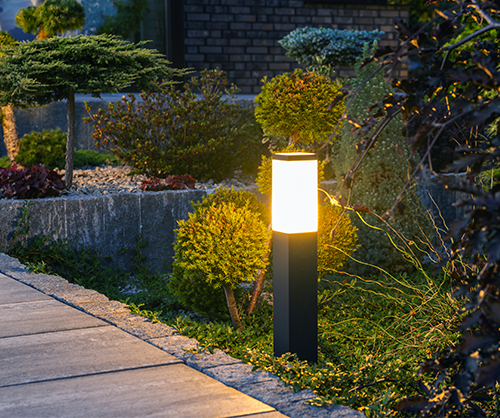
A three-foot garden bollard therefore covers about 12 feet of path before the ground between fixtures drops below the acceptable minimum. This is why real fixture counts run far higher than an average-based calculation suggests, and why experienced designers start from spacing and check the average afterwards.
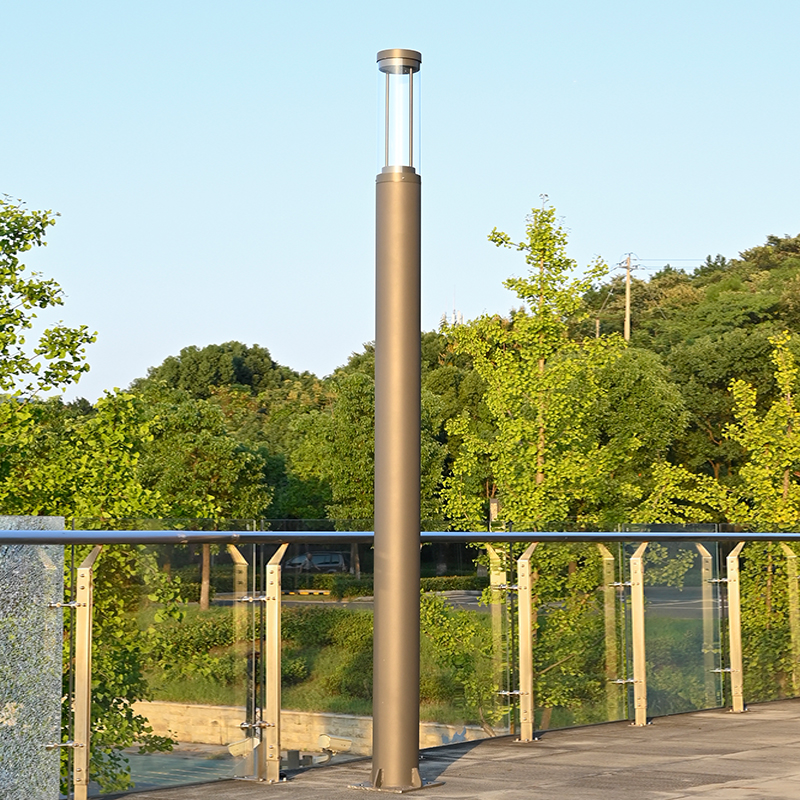 YMLED-6308 Outdoor LED Pathway and Footpath LightFor path spacing and distribution checks, this sealed die-cast aluminum pathway fixture offers secondary optics and multiple wattages up to 55 W.View Product →
Two bollards with identical lumen output can produce very different footcandle readings. A 360-degree head pushes light across the full circle, which suits an open lawn junction or a plaza edge where people approach from any direction. On a straight path, half of that output lands on grass and behind the walkway. A 180-degree or asymmetric distribution concentrates the same lumens on the walking surface, which raises measured footcandles and often allows wider spacing.
Mounting height follows the same logic. Doubling height quarters the illuminance directly below, so a fixture on a 6-foot post needs four times the intensity of the same fixture at 3 feet to hold the same reading. Select post and bollard height against the target footcandle rather than choosing it for appearance and verifying later.
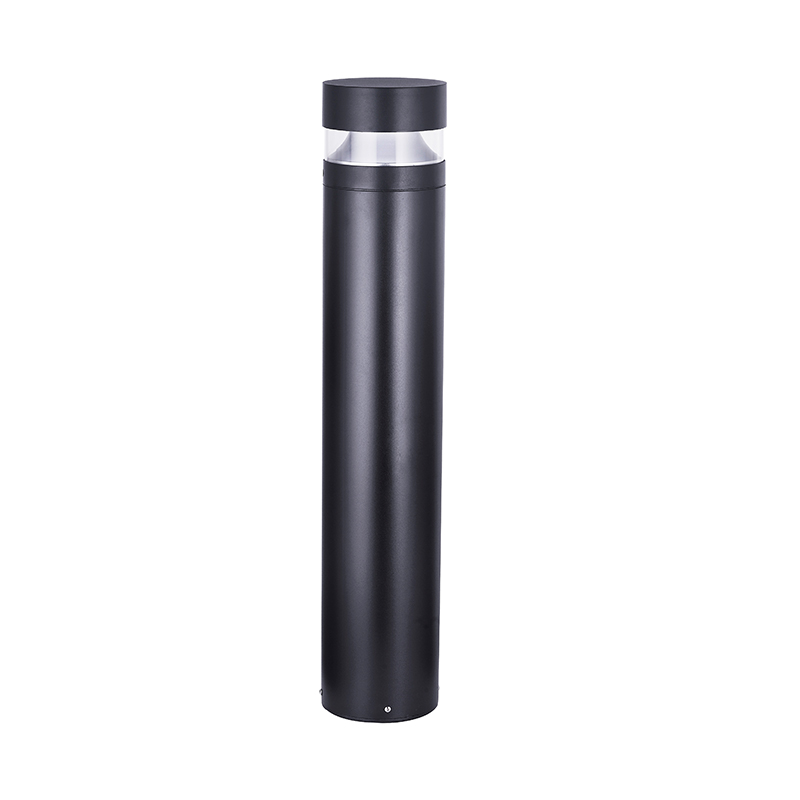 YMLED-6221 360-Degree LED Garden Bollard LightThis omnidirectional IP65 bollard suits path and landscape lighting where even coverage around the post matters, with 600-1000 mm heights.View Product →
Light loss factor is not a theoretical adjustment. It has three real components outdoors. LED lumen depreciation takes a few percent each year, which is why reputable suppliers publish output at L70 or L80 over 50,000 hours. Dirt on the lens is the larger factor in most installations, so gasketed IP65 or IP66 construction with tempered glass or UV stabilized polycarbonate covers matters across a ten-year horizon. Ambient heat and driver quality account for the rest.
Field-replaceable LED modules change this math in a useful way. When the light engine can be swapped without replacing the housing, the installation holds its rated output through multiple maintenance cycles and the LLF assumed at design stage stays closer to reality.
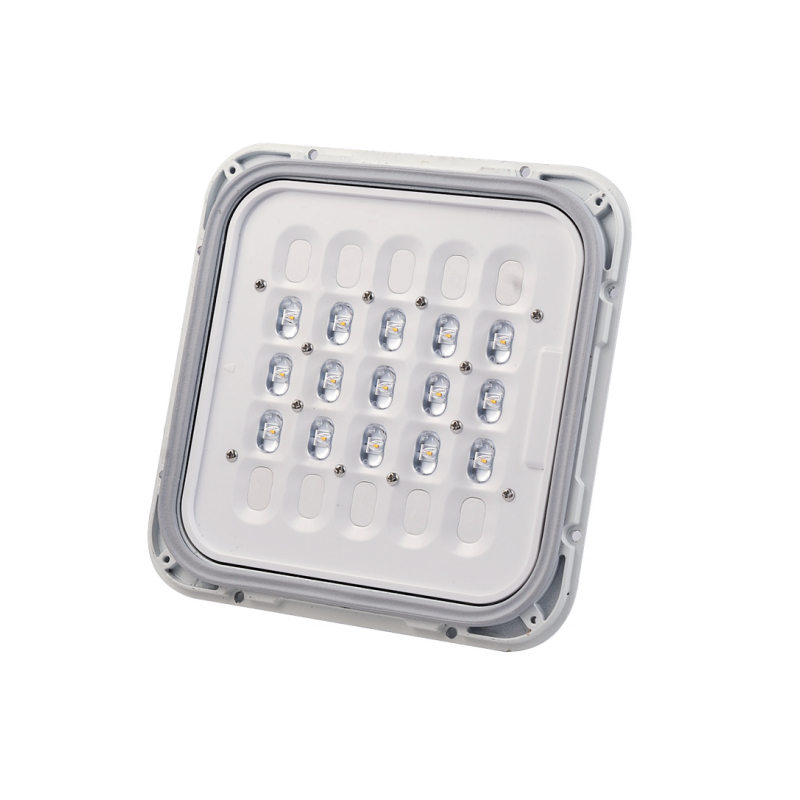 YM6701 Square LED Module for Outdoor FixturesAn upgrade module for streetlights and floodlights, offering IP65/IK08 protection, secondary optics, and 30-55 W versions.View Product →
The calculations above only hold when delivered lumens, CU and distribution come from real photometric testing rather than marketing summaries. Ask any supplier for the IES photometric file covering the exact model and wattage. Loaded into lighting design software, that file produces a point-by-point footcandle grid, a uniformity ratio and a glare check within minutes. Catalogs and specification sheets are useful for a first pass; the photometric file settles the design.
Fixture specifications and model data for the full outdoor range are available for download, and you can request IES files, spacing guidance, or a full layout review through our engineering team. For projects mixing wattages, smart control or solar supply, send the site dimensions and the target illuminance and the team can return a fixture count with recommended spacing.
Keep four numbers in front of you when a footcandle target appears on a specification sheet: the area in square feet, the target illuminance, the delivered lumens per fixture, and the combined CU and LLF losses. Divide one into the other and you have a first-pass fixture count. Then test that count against spacing at roughly four times the mounting height, confirm the beam distribution matches the path geometry, and obtain the photometric file before the order ships. The arithmetic is the easy part, and it is also what keeps a lighting layout from failing its first night inspection.
Related Products
 Private Industrial Park, Liangnong Town, Yuyao City, Ningbo City, Zhejiang Province, China
 +86-13486062091
 +86-574-2222 2345
 +86-574-2267 2345
 info@ym-lighting.com


 English
 中文简体