Oct, 02, 2026
A specifier sends the same request for 200 roadway luminaires to three suppliers and receives three different fixtures, all described as cobra heads. One clamps onto the existing 2-3/8 inch tenon. One throws its beam a lane too wide for the street it is meant to light. The third arrives with a driver that can only be replaced by unbolting the whole housing from the mast arm.
The short answer is that a cobra light fixture is defined by three interfaces: how it clamps to the pole, how it spreads light across the carriageway, and how it opens for service. Buyers who judge a fixture on those three avoid the most expensive part of a street lighting order, which is never the unit price but the rework.
Content
The shape comes from the high pressure sodium era. A long tapered housing reaches out from the pole on a mast arm, placing the light source over the carriageway rather than over the shoulder, with the optical chamber at the far end behind a hinged door and a downward facing lens. The geometry solved one problem well: light belongs over the road, while the pole has to stay at the edge of it.
LED versions keep that geometry and replace the internals. The lamp and ballast give way to an LED module and a constant current driver, the reflector to a secondary optic, and the twist lock photocell to a receptacle that can also carry dimming and monitoring. Because LED output is directional, a cobra head often meets the same lighting class at 60 to 100 W that a 250 W high pressure sodium unit once produced. Confirm that with a photometric file rather than a wattage table.
| Component | Function | Check before ordering |
|---|---|---|
| Housing and heat sink | Carries the light engine and sheds heat | Die cast aluminum, coating class for coastal air |
| Optical chamber and door | Holds the optic and seals the light engine | Tool free opening, captive fasteners, gasket material |
| Lens | Protects optics and shapes the beam | Tempered glass or UV stable polycarbonate |
| Driver | Converts mains power to constant current | Replaceable from below, surge rating, ambient range |
| Slip fitter | Clamps the fixture to tenon or arm | Tenon diameter, entry angle, bolt count |
| Receptacle | Takes photocell, dimming or network node | Three or seven pin NEMA, Zhaga Book 18 |
Two cobra heads with identical wattage can produce completely different results on the ground, because the distribution type decides where the light lands. The IES classifications are the standard shorthand.
Mounting geometry decides whether that distribution can be aimed as designed. Tenon diameter, mast arm length and rise, and the tilt of the slip fitter all shift the effective mounting height and the point where the beam meets the road. Common tenons run from 1-1/4 inch to 2-3/8 inch. A fixed 0 degree fitter on a 15 degree rise arm lights the far shoulder and leaves the near lane dark, which is a specification error rather than a manufacturing defect.
Road lighting specifications are written as lighting classes with minimum maintained illuminance, uniformity ratios and often a glare limit. A fixture has to be selected against those values, so the following numbers matter more than a wattage list.
Housing construction deserves its own check. Die cast aluminum with a proper coating survives coastal air, while thin sheet housings save weight and lose rigidity on long arms. Where a project prefers one integrated housing to a modular assembly, an integrated high performance LED road lighting fixture is a direct comparison to make.
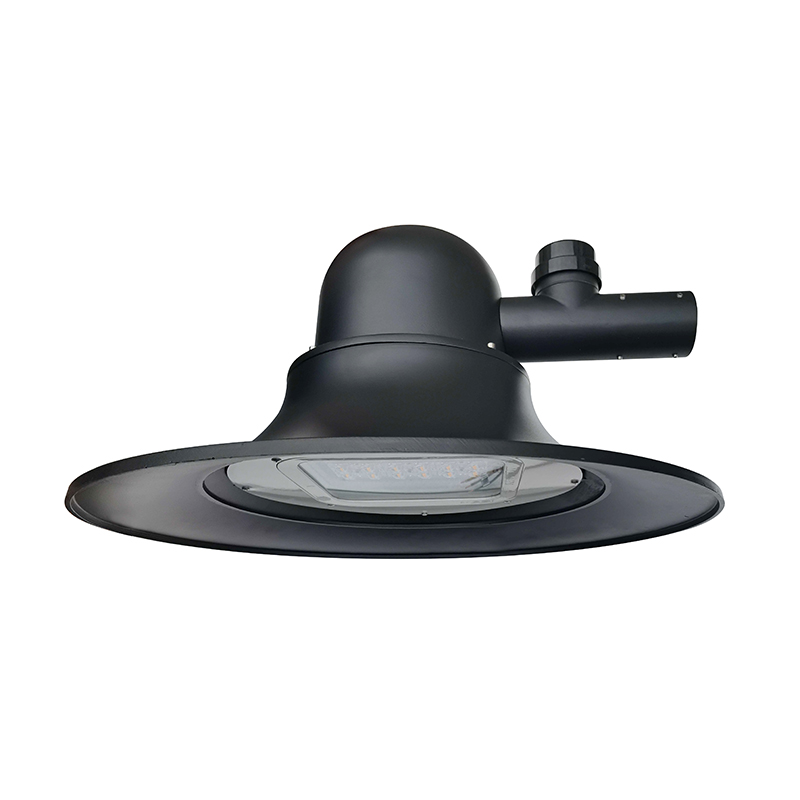
 YMLED-6412 Integrated High-Performance LED Road Lighting FixtureThe YMLED-6412 is a high-performance LED street light designed specifically for urban main roads, expressways, industrial parks, and other similar scenarios. With its ...View Product →
Photocells used to be the whole control story: on at dusk, off at dawn, nothing in between. Today the receptacle on top of the housing is often the reason a specification is written the way it is. A three pin NEMA socket takes a twist lock photocell, while a seven pin NEMA socket or a Zhaga Book 18 receptacle can carry a node for dimming schedules, fault reporting and adaptive lighting that reduces output during low traffic hours.
Specify the receptacle for the control system actually being deployed, because adapters work but add cost and a failure point. Then confirm the driver supports 0-10 V or DALI dimming, since a smart socket on a non dimmable driver produces a node that can only switch the fixture on and off. A street light fitted with a standard control interface keeps that upgrade path open without a second purchase.
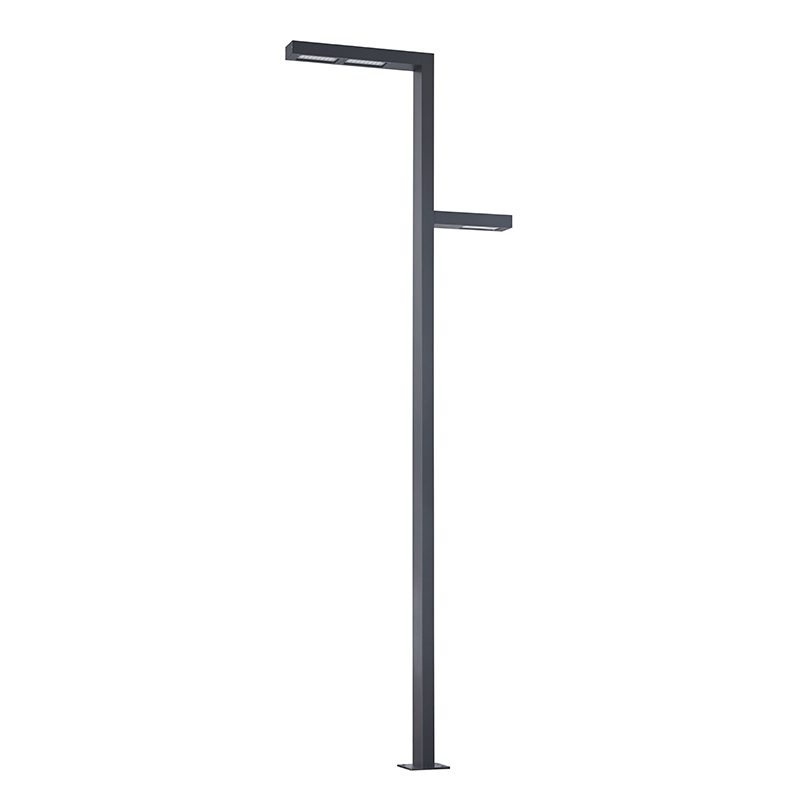
 YMLED-6409 Smart Lighting Equipped With NEMA Socket Aluminum LED Street LightsThe YMLED-6409 is an aluminum LED street light specifically designed for smart lighting, equipped with a NEMA interface, combining modern technology and durability. It...View Product →
Most problems on a street lighting order are documentation problems rather than manufacturing problems. A buyer who receives a sample, a photometric file, an ingress test report and a spare parts list before the production order usually gets what was quoted. A buyer who receives a price and a datasheet gets whatever was already in the warehouse.
Serviceability belongs in the same conversation. Street lighting is a ten to fifteen year asset, and three questions separate a maintainable cobra head from an expensive one. Can the driver be replaced from below without removing the housing from the arm? Is the light engine a standard part or a proprietary board? Is the lens gasket reusable? Aluminum square and round LED modules with their own lens and heat path let a maintenance team swap the light engine while the housing, pole and wiring stay untouched, which also cuts spares inventory across a fleet. Knowing what an LED module is and how it works with the driver makes that comparison straightforward during tendering. A closer look at the company, its factory and its quality control process helps a buyer judge whether a customization request is routine or a new project before committing to a schedule.
On some roads the cable costs more than the light. Where trenching across a finished surface, a protected area or a long rural span would dominate the budget, an off grid luminaire changes the economics. The same applies to temporary roads, staged developments and sites where the grid is unreliable.
The trade offs are real: battery autonomy for three to five cloudy days, panels kept clear of trees and buildings, and a pole or bracket rated for the extra wind load. Output drops in winter at high latitudes, and battery replacement becomes a maintenance line item at around five to seven years. Where wind load or theft is a concern, a vertical solar mast light that integrates panel, battery and luminaire reduces both the exposed surface and the number of parts to install.
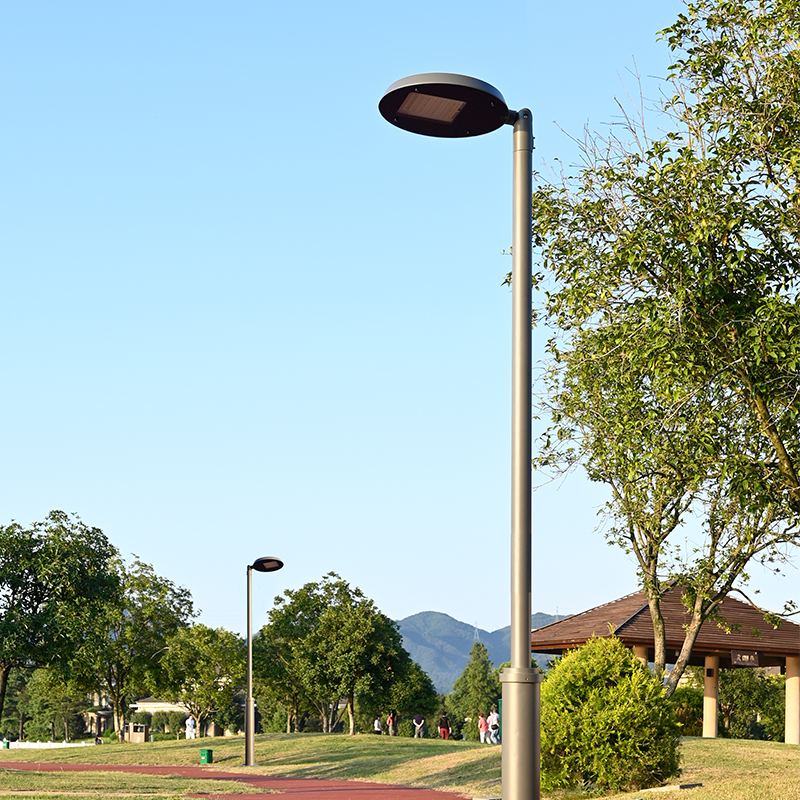
 YMLED-6811 High Efficiency Vertical Solar Street LightThe YMLED-6811 is a high-performance integrated solar LED street light designed for applications requiring high reliability and energy efficiency, such as municipal ro...View Product →
Wattage follows the lighting class rather than the other way round. A residential street at 8 m mounting height usually lands between 40 and 80 W, a collector road at 10 to 12 m between 100 and 150 W. Run the photometric file against the road geometry, check uniformity, then read the wattage from the result.
Usually yes, if the tenon diameter and the arm load rating match. Measure the tenon, note the entry angle, and compare weights, since an LED replacement is normally lighter than the HID unit it replaces. When the arm is corroded or undersized, the bracket is the problem, not the fixture.
Different distribution types, different tilt angles, different mounting heights, and occasionally a driver set to a different output current. Two cobra heads can share a wattage and share nothing else, so compare IES files and mounting details rather than labels.
A cobra light fixture is a simple object with an unforgiving specification process. Confirm the tenon and the arm, pick the distribution type from the road geometry, verify the photometric file, and decide how the unit will be opened in year seven. Do those four things and three competing quotations stop being a risk and become a comparison.
Related Products
 Private Industrial Park, Liangnong Town, Yuyao City, Ningbo City, Zhejiang Province, China
 +86-13486062091
 +86-574-2222 2345
 +86-574-2267 2345
 info@ym-lighting.com


 English
 中文简体
中文简体