












Research Confirms Trade-Offs in the Battle Against Blue Light
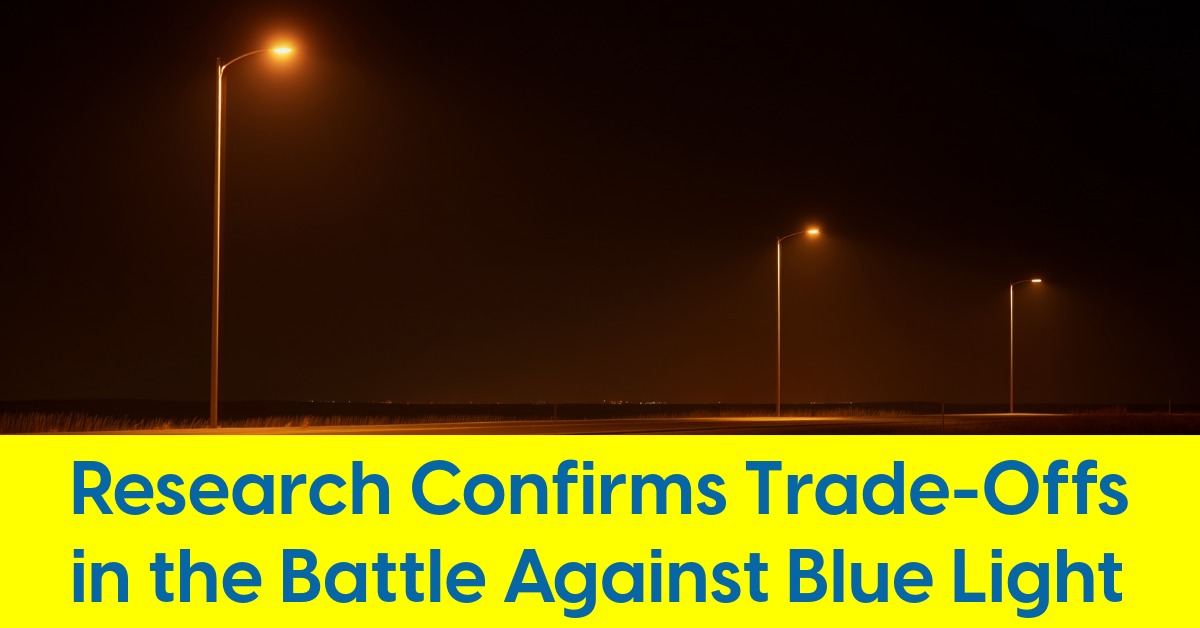
Color rendering, brightness, and longevity vary across light pollution mitigation methods
In the escalating effort to curb outdoor light pollution, new peer-reviewed research has confirmed what many specifiers already suspected: there’s no singular solution to reducing blue light emissions in exterior lighting. The data is in — and every approach comes with trade-offs.
Published this month in LEUKOS, the study compares three prominent strategies for reducing emissions below 500 nm: phosphor-converted amber (PC-amber) LEDs, very low correlated color temperature (CCT) white LEDs, and white LEDs paired with blue-filtering secondary lenses. The research, conducted by the University of Málaga in Spain, takes a rigorous, side-by-side look at efficacy, spectral characteristics, color rendering, and long-term degradation under ultraviolet exposure.
The findings land squarely in the middle of a regulatory moment: the newly released LUNA v2.0 guidelines, which explicitly shift the burden from methods to outcomes.
PC-amber LEDs excel at minimizing blue content, effectively eliminating wavelengths below 500 nm. But that reduction comes at a cost. The study finds that PC-amber solutions “suffer in color rendering index and perceived brightness,” making them less effective for applications requiring facial recognition, visual comfort, or aesthetic coherence.
Very low CCT white LEDs — typically in the 1800–2200K range — strike a middle ground. They offer better visual clarity than amber while significantly reducing blue emissions compared to standard 3000K or 4000K white. But they’re not clean: the study shows “residual blue peaks” persist, enough to violate stricter ecological or dark-sky codes.
Meanwhile, the third strategy — blue-filtered secondary lenses — initially looks promising. Filters applied to standard white LEDs reduce short-wavelength emissions while preserving light output and acceptable color rendering. However, the study’s degradation analysis warns that these filters “show measurable loss of filtering performance under prolonged UV exposure,” particularly in environments with high solar radiation.