Jul, 10, 2026
The service life of a Light Pole depends primarily on the pole material, the installation environment, the quality of the protective coating system, and the rigor of periodic maintenance. As a practical reference: galvanized steel light poles typically last 25 to 35 years in standard environments; aluminum poles last 30 to 40 years; fiberglass composite poles last 40 to 50 years; and prestressed concrete poles have documented service lives of 40 to 60 years under normal conditions.
These are design-life figures based on structural integrity -- the time until the pole can no longer safely support its rated load without repair or replacement. In practice, the actual service life of any individual pole is determined by the specific combination of environmental exposure, maintenance history, and load history it experiences. A steel pole in a coastal salt-air environment with no maintenance may fail structurally in 12 to 15 years, while an identical pole in a dry inland climate with regular coating maintenance can exceed 40 years. Understanding the factors that govern light pole service life is the most practical way to protect your infrastructure investment and plan replacement budgets accurately.
Content
Material selection is the single most important determinant of light pole service life before any environmental or maintenance factors are applied. Each material has a distinct degradation mechanism, and understanding these mechanisms helps predict where failures will occur and how to prevent or delay them.
Galvanized steel is the most widely used material for commercial, roadway, and area lighting poles worldwide. Hot-dip galvanizing applies a zinc coating of 85 to 140 micrometers thickness to the steel substrate, providing both barrier protection and cathodic (sacrificial) protection against corrosion. As long as the zinc coating remains intact, the underlying steel is protected even if minor scratches or chips expose the steel surface, because zinc corrodes preferentially to protect the steel beneath.
The zinc coating on hot-dip galvanized steel typically provides a corrosion-free period of 20 to 35 years in rural and suburban environments, and 10 to 20 years in industrial or coastal environments, as documented in ISO 14713-1 (Guidelines for the protection against corrosion of iron and steel in structures -- Zinc and aluminium coatings). Once the zinc is fully consumed, bare steel corrosion begins, and without intervention, structural section loss follows.
The most vulnerable zone of a galvanized steel pole is the at-grade zone -- the area 6 to 12 inches above and below the soil surface -- where moisture, oxygen, chloride from road salting, and biological activity concentrate. Industry inspection data shows that over 70% of structural failures in steel light poles originate in the at-grade zone, even on poles whose above-grade sections appear in good condition (source: AASHTO Roadway Lighting Design Guide, 2018). This makes at-grade inspection the critical maintenance activity for galvanized steel poles.
Aluminum light poles offer inherently superior corrosion resistance compared to steel because aluminum forms a stable, self-healing aluminum oxide layer on its surface that prevents ongoing oxidation. This property makes aluminum poles the preferred choice for coastal environments, areas with high atmospheric chloride, and locations where road salt is applied heavily -- environments that dramatically shorten steel pole service life.
Aluminum poles do not require a zinc coating or paint system for basic corrosion protection, though anodizing or powder coating is typically applied for appearance and to prevent the white oxidation (aluminum hydroxide) surface deposits that develop on untreated aluminum in wet environments. The structural service life of aluminum poles in most environments is 30 to 40 years, limited not by corrosion but by fatigue cracking at welded joints under cyclic wind loading and by impact damage vulnerability -- aluminum is significantly less ductile than steel and more susceptible to permanent deformation from vehicle strikes.
One important exception is high-pH (alkaline) soil environments, where aluminum can experience accelerated corrosion. Sites with soil pH above 8.5, or with significant concrete contact at the base (due to concrete's alkalinity), may require protective wrapping or coating of the aluminum pole at the buried section to prevent alkali-induced corrosion.
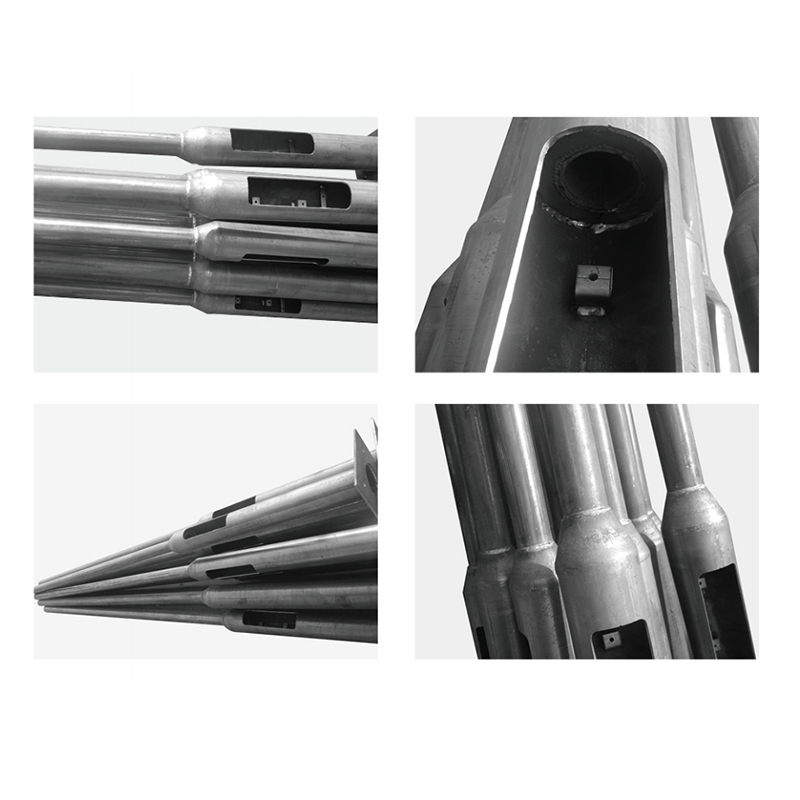
Fiberglass Reinforced Polymer (FRP) light poles are manufactured from glass fibers embedded in a thermoset resin matrix, typically polyester or vinyl ester. They are completely immune to electrochemical corrosion -- they neither rust nor oxidize -- making them the material of choice for the most aggressive corrosion environments: marine waterfronts, chemical plant perimeters, wastewater treatment facilities, and areas where galvanic corrosion between dissimilar metals is a concern.
The primary degradation mechanisms for FRP poles are UV degradation of the resin surface layer (which can be mitigated with UV-stabilized gel coats or UV-resistant resins) and impact damage from vehicles or equipment. Properly specified and protected FRP poles achieve design service lives of 40 to 50 years in aggressive environments where steel poles would require replacement within 15 to 20 years. The higher initial cost of FRP poles -- typically 40 to 80% more than equivalent steel poles -- is frequently recovered through reduced maintenance expenditure and extended replacement cycles over a 40-year project horizon.
Spun and prestressed concrete poles are widely used for highway and major roadway lighting in many regions, particularly in Asia, the Middle East, and developing markets where concrete production cost is low relative to steel. Concrete poles are immune to corrosion of the outer surface, highly resistant to vandalism, and capable of service lives of 40 to 60 years under normal operating conditions.
The limiting factor for concrete pole service life is the corrosion of the embedded prestressing steel wires if the concrete cover is compromised by cracking, carbonation, or chloride ingress. Once chloride reaches the prestressing steel, corrosion product expansion cracks the concrete further, accelerating degradation in a self-reinforcing cycle. Impact damage from vehicles -- which causes visible splitting or spalling in concrete poles -- is also a significant cause of premature replacement.
| Material | Design Service Life | Primary Degradation Mechanism | Best Environment | Worst Environment |
|---|---|---|---|---|
| Galvanized Steel | 25 -- 35 years | At-grade corrosion after zinc depletion | Dry inland, rural | Coastal, road-salt zones |
| Aluminum | 30 -- 40 years | Fatigue at welds; impact deformation | Coastal, marine, decorative streetscapes | High-pH soils; vehicle strike zones |
| Fiberglass (FRP) | 40 -- 50 years | UV resin degradation; impact damage | Marine, chemical, wastewater environments | High vehicle impact risk areas |
| Prestressed Concrete | 40 -- 60 years | Rebar corrosion from chloride ingress; impact spalling | Low-impact, stable environments | High vehicle impact; marine chloride zones |
The same steel light pole installed in two different locations can have a service life ranging from 12 years to over 40 years depending on environmental conditions alone. Understanding which environmental factors are most damaging allows project managers and asset managers to apply appropriate material selection, coating specification, and maintenance intensity for each installation context.
Salt-laden air in coastal environments is the most aggressive corrosion exposure for steel light poles. The ISO 9223 corrosivity classification system defines five atmospheric corrosivity categories (C1 through C5), with C5-M (Marine) representing the highest corrosion severity. At C5-M exposure, unprotected carbon steel loses approximately 200 to 700 micrometers of thickness per year (source: ISO 9224, Corrosion of metals and alloys -- Basic values for the corrosion rates of standard specimens, 2012). A standard galvanized steel pole with 100-micrometer zinc coating in a C5-M environment may exhaust its zinc protection in as few as 3 to 5 years, leaving bare steel exposed.
For coastal installations within 1 kilometer of the shoreline, aluminum poles, FRP poles, or duplex-coated steel poles (hot-dip galvanized plus liquid epoxy or polyurethane topcoat) are the appropriate specification. Standard galvanized poles without topcoat in these locations represent a false economy -- the 5 to 10-year replacement cycle cost far exceeds the premium for a corrosion-resistant alternative with a 30 to 40-year life.
In northern climates where sodium chloride or magnesium chloride is applied to roads during winter, light poles at roadsides accumulate chloride salt splash and spray in the at-grade zone throughout the winter season. This chloride accelerates zinc depletion and initiates crevice corrosion at the soil-air interface. Studies of in-service steel light poles in northern US states have found at-grade wall thickness losses of 30 to 50% in as little as 15 to 20 years in high-salt-application zones (source: FHWA Corrosion Technology Laboratory, Steel Pole Inspection and Assessment Guide, 2019).
For roadside poles in salt application zones, supplemental corrosion protection at the at-grade zone -- including coal tar epoxy coating, petrolatum tape wrap, or sacrificial anode attachment -- can extend effective service life by 10 to 15 years at modest cost per pole.
Industrial areas with airborne sulfur dioxide, hydrogen sulfide, ammonia, or other corrosive chemical emissions represent ISO C4 to C5-I (Industrial) atmospheric exposure. Steel poles in these environments require either duplex coating systems or material substitution to FRP. Chemical plants, wastewater treatment facilities, fertilizer storage areas, and pulp and paper mill sites are the most common industrial environments where standard galvanized poles have proven inadequate.
Even in corrosion-benign environments, light poles are subject to structural fatigue from cyclic wind loading. Every wind gust cycle applies a bending stress to the pole, and after sufficient cycles, fatigue cracks can initiate at stress concentration points -- most commonly at the hand hole opening, at weld toes on arm connections, and at the pole-to-base plate weld. AASHTO fatigue design criteria for luminaire supports specify a design life of 500 million wind loading cycles, which at typical mid-latitude wind frequency corresponds to a structural fatigue life of approximately 25 to 50 years depending on wind exposure category (source: AASHTO Standard Specifications for Structural Supports for Highway Signs, Luminaires, and Traffic Signals, 2015).
Poles in high-wind zones -- coastal areas, open plains, mountain passes, and high-rise urban canyon environments -- experience higher cycle frequencies and stress amplitudes, reducing effective fatigue life. For installations in ASCE 7 Wind Exposure Category D (open terrain with wind exposure in all directions), structural analysis by a qualified engineer is recommended for poles taller than 40 feet or for poles supporting large-EPA luminaire configurations.
In high UV environments -- desert climates, high-altitude installations, and low-latitude regions -- organic coatings on steel and aluminum poles experience accelerated degradation. Chalking, fading, cracking, and adhesion loss in paint or powder coat systems reduce barrier protection and allow moisture ingress to the substrate. Thermal cycling between day and night temperatures also stresses coating adhesion through differential thermal expansion between the coating and metal substrate. In high-UV environments, specifying a UV-stabilized fluoropolymer (PVDF) topcoat or a two-pack polyurethane finish instead of standard polyester powder coat can extend the effective coating life from 8 to 12 years to 20 to 25 years, significantly extending the interval before recoating or replacement is required.
For steel light poles, the coating system is the primary life-extension mechanism. The difference between a 15-year and a 35-year steel pole service life in a moderately corrosive environment is almost entirely determined by the quality and maintenance of the coating system. Understanding coating system specifications helps buyers and specifiers make decisions that deliver genuine lifecycle value rather than lowest first cost.
| Coating System | Typical System Composition | Expected Life to First Maintenance (C3 Environment) | Expected Life to First Maintenance (C5 Environment) |
|---|---|---|---|
| Hot-dip galvanize only | 85 to 140 um zinc coating | 20 -- 30 years | 5 -- 10 years |
| Hot-dip galvanize + polyester powder coat | Zinc + 60 to 80 um powder coat | 25 -- 35 years | 10 -- 15 years |
| Hot-dip galvanize + epoxy primer + polyurethane topcoat (duplex) | Zinc + 50 um epoxy + 50 um PU | 30 -- 40 years | 15 -- 25 years |
| Thermal spray zinc + epoxy + PVDF topcoat | 200 um TSZ + 50 um epoxy + 30 um PVDF | 40+ years | 25 -- 35 years |
The ISO 12944 series (Paints and varnishes -- Corrosion protection of steel structures by protective paint systems) provides a framework for specifying coating systems by corrosivity category and target durability. For light poles in C4 or C5 environments, specifying a duplex system (galvanize plus liquid topcoat) at the procurement stage adds 5 to 15% to the pole cost but doubles or triples the coating service life, representing one of the highest-return investments available in light pole procurement.
Because the at-grade zone is where corrosion failures most commonly originate, supplemental protection specifically targeting this zone is a cost-effective life extension measure for steel poles in moderate-to-high corrosivity environments. Options include:
The relationship between maintenance investment and light pole service life is well-documented and consistent: poles that receive scheduled inspection and prompt remedial treatment consistently achieve lives at or above their design specification, while unmaintained poles frequently fail 30 to 50% short of their design life. For a municipal or commercial lighting asset portfolio, the economic case for proactive maintenance is compelling -- the cost of maintaining a pole population is invariably less than the cost of accelerated replacement driven by neglect.
| Maintenance Activity | Recommended Frequency | Purpose and Notes |
|---|---|---|
| Visual above-grade inspection | Annual | Check for coating damage, rust staining, structural deformation, vehicle impact damage, lean, and luminaire condition |
| At-grade zone inspection (probe/excavate) | Every 5 years (every 3 years in C4-C5 environments) | Expose and visually inspect the at-grade zone for corrosion pitting and coating loss; use thickness gauge for quantitative assessment |
| Ultrasonic thickness measurement | Every 5 to 10 years for steel poles over 15 years old | Non-destructive measurement of remaining wall thickness at the at-grade zone and below-grade section; compare to original specification |
| Anchor bolt torque check | Every 3 to 5 years | Verify anchor bolt nuts remain at specified torque; cyclic wind loading can cause progressive loosening |
| Coating touch-up and spot repair | As needed following annual inspection | Repair coating damage immediately to prevent moisture ingress and substrate corrosion initiation |
| Full recoating | When coating condition rating drops below acceptable threshold; typically 15 to 25 years | Abrasive blast to bare metal and reapply full coating system for maximum adhesion and longevity |
| At-grade supplemental treatment | At first 5-year inspection or when corrosion is detected | Apply petrolatum tape, coal tar epoxy, or install protective sleeve as appropriate for the environment |
| Foundation integrity check | Every 10 years | Inspect concrete foundation for cracking, settlement, or spalling; verify pole base is secure and anchor bolts are not corroded |
Cities and municipalities that have implemented systematic light pole inspection programs report that proactive maintenance reduces the incidence of unexpected structural failures by 75 to 85% compared to reactive-only maintenance approaches, and extends the average in-service life of their steel pole population by 8 to 12 years (source: FHWA Asset Management for Transportation Infrastructure, 2020). For a large pole population, this life extension translates directly to deferred capital replacement expenditure measured in millions of dollars.
Determining the remaining service life of an in-service light pole requires both visual assessment and non-destructive testing (NDT) of the structural section. The following methods are used by infrastructure asset managers and inspection engineers to make evidence-based remaining life assessments:
Visual inspection is the baseline assessment tool and the most cost-effective screening method for large pole populations. A trained inspector evaluates the pole for the following condition indicators:
Visual condition is typically rated on a standardized scale. AASHTO uses a 0 to 9 condition rating scale for light poles, where a rating of 4 (poor condition with significant element deterioration) triggers engineering review for replacement or repair, and a rating below 3 indicates imminent structural concern requiring immediate action.
Ultrasonic thickness (UT) testing uses high-frequency sound pulses to measure the wall thickness of the steel pole shaft from the outside surface, without requiring access to the interior or removal of soil from around the buried section. A calibrated UT gauge is placed against the pole surface and reads thickness to an accuracy of +/- 0.1 mm, allowing comparison of the measured thickness against the original design specification.
The standard threshold for steel light pole replacement based on wall thickness loss is:
These thresholds are consistent with AASHTO guidance and with the practices of major US state DOTs including Texas DOT, Florida DOT, and the California DOT, all of which have published light pole inspection programs using UT testing as the primary quantitative assessment tool.
For large pole populations where UT testing of every pole at every inspection cycle is impractical, magnetic flux leakage (MFL) scanning provides a faster screening tool. An MFL scanner is passed around the pole circumference at the at-grade zone, detecting anomalies in the magnetic field that indicate metal loss from corrosion pitting. MFL scanning can survey a pole in under 2 minutes, enabling rapid screening of large populations to identify which poles require follow-up UT measurement and engineering assessment.
For poles where visual and NDT results are ambiguous -- for example, where significant corrosion is observed in the at-grade zone but the extent of wall thickness loss varies around the circumference -- proof load testing can directly confirm whether the pole retains sufficient structural capacity for its design wind load. Load testing applies a measured lateral load to the pole and measures deflection and residual deflection, confirming structural integrity before the pole is returned to service.
The decision between repairing a deteriorated light pole and replacing it is an economic and safety judgment that requires quantitative input. The following framework provides practical decision criteria for asset managers and project engineers:
A simple life cycle cost (LCC) comparison is the most rigorous basis for repair vs replace decisions. As an example: if a 20-year-old steel pole has sustained 30% at-grade wall thickness loss, the options are:
In this example the costs per year of service are similar, but Option A defers a large capital outlay while Option B resets the service life clock and eliminates recurring inspection and repair costs on a deteriorating asset. When the pole population is large and many poles are approaching end of life simultaneously, a planned group replacement program typically delivers better economics than piecemeal repair of individual poles, because mobilization costs for installation equipment are spread across multiple poles.
For project owners, facility managers, and municipal asset managers looking to extract maximum value from their light pole infrastructure, the following evidence-based strategies have the strongest impact on achieved service life:
A well-specified, properly maintained Light Pole represents a long-term infrastructure investment that reliably achieves and often exceeds its design service life. The difference between a 20-year pole and a 40-year pole in the same location is rarely the pole itself -- it is the specification decisions made at procurement and the maintenance decisions made throughout service. Getting both right is the most effective strategy available for maximizing the return on your lighting infrastructure investment.
Even with good maintenance, all light poles eventually reach the end of their economically serviceable life. Recognizing end-of-life indicators promptly is important for safety -- a structurally inadequate pole that remains in service represents an unacceptable risk of collapse onto pedestrians, vehicles, or property. The following are the most reliable end-of-life indicators:
When any of these conditions is confirmed, the appropriate response is removal from service and replacement -- not further repair. A light pole that has reached structural end of life is not a maintenance issue; it is a safety hazard. Replacement should be treated as an urgent capital action, not a deferrable maintenance task.
We were pleased to take part in the 2026 Guangzhou International Lighting Exhibition, held from June 9 to June 12, 2026 at the China Import and Export Fair Complex in Guangzhou. As one of the largest professional lighting trade fairs in Asia, the exhibition attracted visitors and buyers from over 100 countries and regions, providing an important platform to showcase new products and connect with partners from around the world.
Our team welcomed visitors at Hall 4.1, Booth B51, where we presented a range of outdoor and landscape lighting solutions, including integrated solar garden lights and minimalist landscape street lights. Throughout the show, we had the opportunity to demonstrate our products in person and discuss technical details and custom project requirements with visiting partners and buyers.
We would like to thank everyone who visited our booth and look forward to continuing these conversations as we move ahead with new projects and partnerships.
Related Products
 Private Industrial Park, Liangnong Town, Yuyao City, Ningbo City, Zhejiang Province, China
 +86-13486062091
 +86-574-2222 2345
 +86-574-2267 2345
 info@ym-lighting.com


 English
 中文简体
中文简体