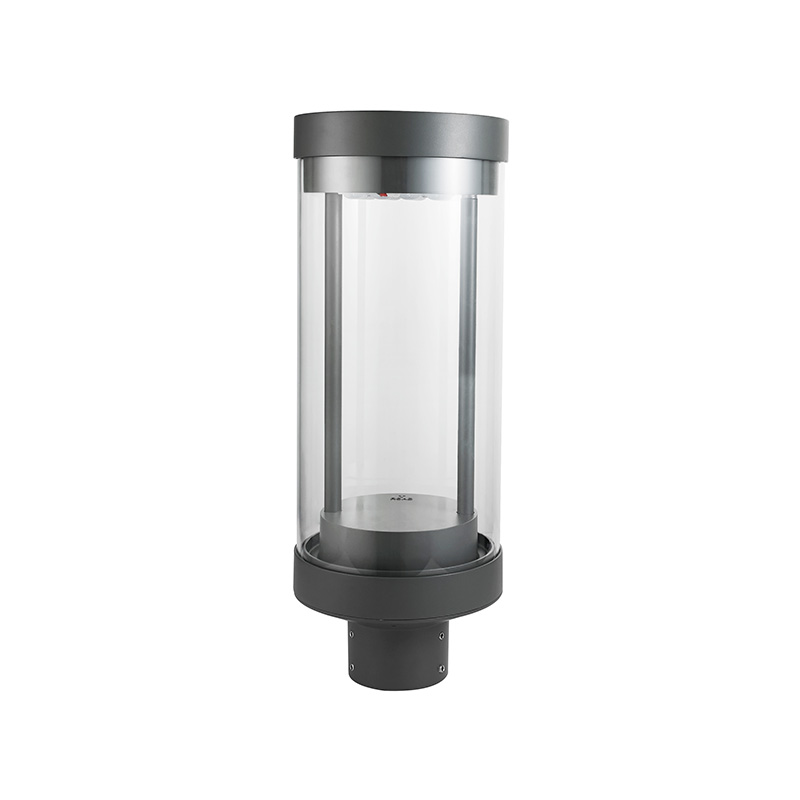
May, 22, 2026
To choose the best waterproof post top light, evaluate six key factors: IP and IK protection rating matched to the installation environment, housing material and corrosion resistance, light source quality and colour rendering index (CRI), colour temperature suited to the application, fixture size and pole compatibility, and control options including dimming capability. A post top light that performs reliably for years in outdoor conditions — whether in a residential garden, a commercial landscape, or a public park pathway — must pass all six criteria, not just one or two. Compromising on any of them risks early failure, poor aesthetics, or expensive maintenance in locations that are often difficult to access.
Content
The IP (Ingress Protection) rating and IK (Impact Protection) rating together define how well a post top light withstands the two most common causes of outdoor fixture failure: moisture and physical impact. Understanding both is essential before any other specification is considered.
The IP rating consists of two digits: the first rates dust resistance (0–6), the second rates water resistance (0–9). For post top lights installed in open outdoor environments, the minimum acceptable rating is IP65 — fully dust-tight and protected against low-pressure water jets from any direction. This rating withstands rain, garden irrigation spray, and standard hosepipe cleaning without water entering the electrical components.
In environments with persistent humidity, coastal salt spray, or frequent heavy rain, specifying IP66 or IP67 provides a meaningful additional margin. IP66 resists powerful water jets; IP67 withstands temporary immersion to 1 metre for 30 minutes — appropriate for low-lying installations in areas prone to flooding or pooling during heavy rainfall.
The IK rating is less commonly specified but critically important for post top lights in accessible public or semi-public locations — parks, pathways, car parks, and commercial landscapes where the fixture may be struck by vehicles, equipment, or deliberate vandalism. The IK scale runs from IK00 (no protection) to IK10 (protected against 20 joules impact). IK08 is the recommended minimum for most outdoor post top applications, corresponding to resistance against 5 joules of impact energy — equivalent to a 1.7 kg mass dropping from 0.3 metres.
A fixture combining IP65 and IK08 addresses both the moisture and impact hazards present in typical outdoor environments, while providing a practical and cost-effective specification baseline. More demanding locations such as roadside lighting and urban public spaces may warrant IP66/IK09 or higher.
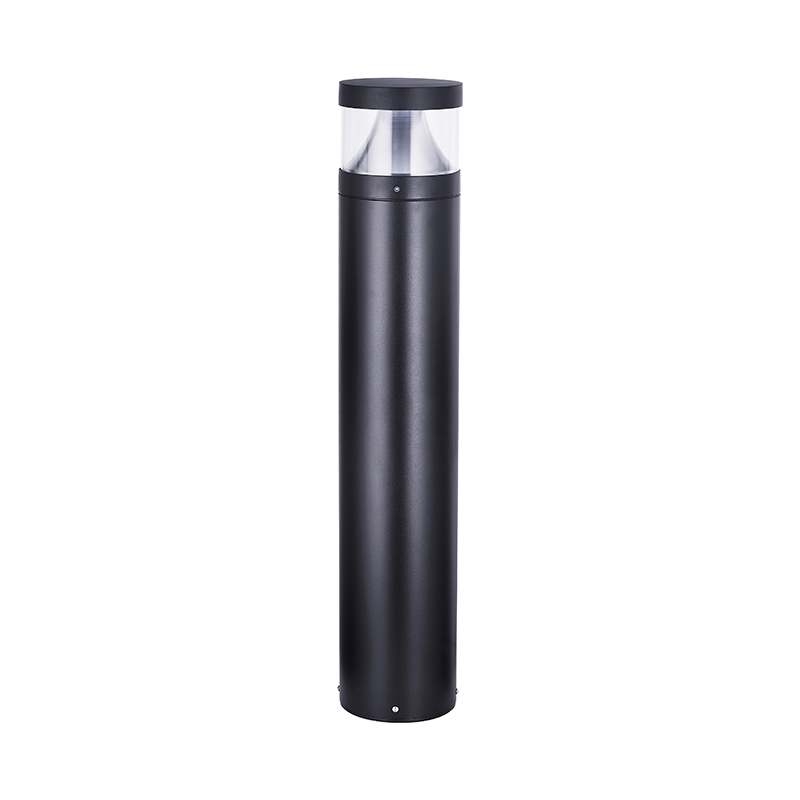
The housing material of a post top light is as important as its electrical specification. A poorly specified housing will corrode, discolour, or mechanically fail years before the LED light source reaches the end of its rated life — undermining the cost and longevity advantages that LED technology offers.
Die-cast aluminium — particularly 6063-T5 grade — is the preferred housing material for professional-grade outdoor post top lights. The 6063 alloy offers an excellent combination of structural strength, low weight, and natural corrosion resistance. The T5 temper designation indicates the alloy has been artificially aged after forming, improving its hardness and dimensional stability.
Equally important is the surface treatment applied to the aluminium housing. A UV-resistant polyester powder coating provides a durable, fade-resistant colour finish that withstands prolonged sun exposure without yellowing or chalking — a common failure mode of lower-quality paint finishes on cheaper die-cast housings. The best-specified post top lights offer RAL colour customisation, allowing the fixture to be matched precisely to the landscape design, architectural palette, or local authority specification requirements.
In coastal locations, marine environments, or industrial areas where the atmosphere contains elevated levels of salt, chemicals, or pollutants, standard powder coating is insufficient. Post top lights for these applications require additional anti-corrosion treatment — typically a multi-stage process that achieves salt spray resistance exceeding 1,000 hours in accordance with ISO 9227 testing. This specification is a meaningful benchmark: fixtures that pass a 1,000-hour salt spray test are expected to resist corrosion for many years in real coastal conditions, compared to standard powder-coated aluminium that may show surface corrosion within 2–3 years in aggressive marine environments.
Polycarbonate and ABS plastic housings are used in lower-cost post top lights and can provide adequate performance in mild environments when UV-stabilised grades are specified. However, plastic housings are susceptible to impact cracking at low temperatures, cannot achieve the same IK impact rating as aluminium, and are more prone to colour change and surface degradation after several years of UV exposure. Stainless steel housings offer excellent corrosion resistance but add significant weight and cost, making them appropriate for premium architectural installations rather than standard landscape lighting.
The LED light source and driver inside a post top light determine its brightness, colour quality, energy efficiency, and how long the fixture delivers useful illumination before maintenance is required. These internal specifications are where the difference between professional-grade and commodity post top lights is most clearly expressed.
Post top lights with professionally specified light sources — whether SMD LEDs in 3030 or 2835 package sizes, COB (chip-on-board) arrays, or E27 socket configurations — offer measurably better efficacy, consistency, and long-term performance than fixtures using unspecified or economy LED chips. Key indicators of light source quality include:
CRI measures how accurately the light source renders the colours of illuminated objects compared to natural daylight. For post top lights in garden, landscape, and park pathway applications, CRI directly affects how plants, paving materials, and architectural features appear at night. A minimum CRI of Ra 80 is recommended for most landscape applications — at this level, the greens of grass and foliage, the warm tones of natural stone, and the colours of garden plantings are rendered with sufficient fidelity to create an attractive nighttime environment. CRI Ra 70 is acceptable for pathway safety lighting where colour accuracy is less critical than visibility. Premium installations with high aesthetic expectations benefit from CRI Ra 90+.
Colour temperature, measured in Kelvin (K), determines the visual character of the light — whether it appears warm and inviting or cool and functional. The choice of colour temperature for a post top light significantly affects the atmosphere of the outdoor space it illuminates, and the best post top lights offer a range of options to accommodate different project requirements.
| Colour Temperature | Appearance | Best Application | Notes |
|---|---|---|---|
| 2,200K–2,700K | Very warm amber-white | Residential gardens, villa courtyards, heritage landscapes | Maximises atmospheric warmth; least disruptive to wildlife and dark sky |
| 3,000K | Warm white | Garden pathways, park walkways, commercial landscapes | The most versatile choice for landscape lighting; welcoming without being harsh |
| 4,000K | Neutral/cool white | Car parks, commercial entrances, functional public pathways | Higher visibility; less atmospheric — best for function-prioritised areas |
| 5,000K–6,500K | Cool daylight-white | Security areas, industrial perimeters, high-visibility zones | Maximum visual acuity; not recommended for amenity or residential use |
Post top lights with a wide adjustable colour temperature range — such as 2,200K to 6,500K configurable at point of order — provide maximum specification flexibility for projects that include multiple zones with different lighting requirements, without needing to stock multiple fixture variants.
Post top lights are available in a range of sizes and heights, and selecting the right dimensions for the application requires considering both visual proportions and the pole or mounting system they will be fitted to.
For lawn and garden post top fixtures, typical overall heights range from 600 mm to 1,000 mm. These sizes correspond to different installation contexts:
When specifying post top lights for a project involving existing poles or specified mounting hardware, confirm the post top entry diameter and mounting flange dimensions match the available pole top fittings. Incompatible dimensions require adapters that add cost and can introduce points of water ingress if not properly sealed.
The control capability of a post top light affects both its operational flexibility and its long-term running cost. Basic switch-controlled fixtures are adequate for simple on/off operation, but specifying dimming capability from the outset adds significant value — both in terms of energy management and lighting scene versatility.
Simple mains switching via a time clock or photocell controller is sufficient for many residential and low-complexity commercial applications. All quality post top lights support this mode as a minimum. A photocell (dusk-to-dawn sensor) provides automatic on/off without manual intervention, maintaining consistent operation regardless of seasonal changes in daylight hours.
DALI (Digital Addressable Lighting Interface) is the professional standard for dimming control in commercial and infrastructure lighting. Post top lights with DALI-compatible drivers can be individually addressed and dimmed within a networked lighting control system, enabling:
For projects spanning multiple countries or regions with different mains voltage standards, selecting post top lights with a wide voltage input range — typically 100–277V AC or 100–240V AC — eliminates the need to specify separate products for different electrical infrastructure standards. This simplifies procurement, reduces inventory complexity for international installers, and ensures reliable operation even in locations with unstable or variable grid voltage.
Use this checklist when evaluating any post top light product to confirm it meets all requirements before specification or purchase:
Selecting the right post top light is only part of achieving a reliable outdoor lighting installation. Installation quality has an equally significant impact on long-term performance:
Related Products
 Private Industrial Park, Liangnong Town, Yuyao City, Ningbo City, Zhejiang Province, China
 +86-13486062091
 +86-574-2222 2345
 +86-574-2267 2345
 info@ym-lighting.com


 English
 中文简体
中文简体