Aug, 21, 2026
Yes, installing a light pole almost always requires a concrete pour, since the foundation needs enough mass and depth to resist the overturning forces created by wind pressure acting on the pole and fixture. A simple hole without a properly formed concrete base cannot provide the structural anchoring needed to keep the pole stable over years of exposure to wind, vibration, and soil movement. Engineering guidelines commonly used in outdoor lighting design typically call for foundation depths of 8 to 12 percent of the total pole height, which is why even relatively short poles require a substantial concrete footing rather than a shallow, unreinforced hole.
Content
A light pole acts like a long lever arm, and wind pressure against the pole shaft and fixture creates significant overturning force at the base. Concrete provides the mass and rigidity needed to resist this force and keep the pole securely anchored in place.
Manufacturers of a properly engineered Light Pole typically provide foundation specifications alongside pole dimensions, since the two must be matched together to achieve the structural performance the pole was designed for.
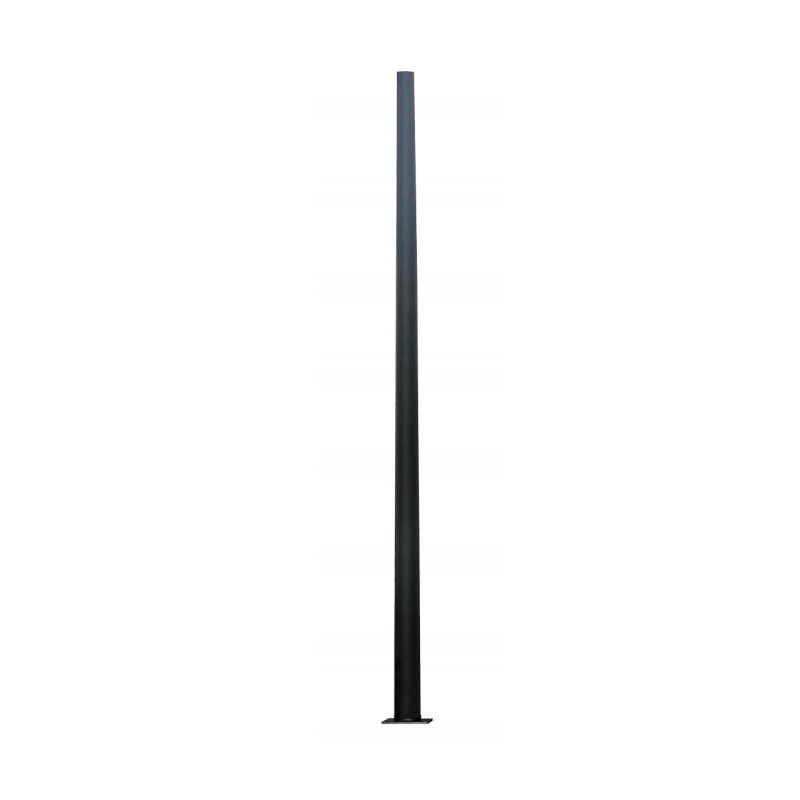
Foundation dimensions are not arbitrary, they are calculated based on several site-specific and pole-specific factors that determine how much concrete mass is needed to keep the structure stable.
| Factor | Effect on Foundation Size |
| Pole height | Taller poles require deeper, larger diameter foundations |
| Fixture weight and arm length | Heavier or wider fixtures increase overturning force |
| Soil type and bearing capacity | Weaker soils require larger foundation volume to compensate |
These variables are typically calculated together by a structural engineer, particularly for taller commercial or roadway poles where the consequences of an undersized foundation are more severe than with shorter decorative installations.
While exact specifications vary by project, general industry guidelines provide a useful starting point for understanding how much concrete a typical light pole installation requires.
These figures are general references, and actual project specifications should always follow the engineering documentation provided for the specific pole model and regional building code requirements.
In regions that experience freezing temperatures, foundation depth must also account for the local frost line, which is the depth to which the ground freezes during winter months.
If a foundation is not poured below the frost line, seasonal freeze-thaw cycles can cause the concrete base to shift or heave over time, gradually loosening the pole's anchoring and creating a leaning or unstable installation.
Frost line depth varies significantly by region, meaning a foundation depth sufficient in a mild climate may be inadequate in a northern region with deep seasonal ground freezing, which is why local building codes typically specify minimum foundation depths for outdoor structures.
The concrete pour is only one part of a successful foundation installation, proper anchor bolt placement and adequate curing time are equally important to the pole's long-term stability.
Anchor bolts must be positioned precisely to match the pole's base plate bolt pattern, since even small misalignments can create installation problems or introduce uneven stress on the base plate once the pole is mounted.
Concrete gains the majority of its structural strength during the first one to two weeks of curing, and mounting a pole before the foundation reaches adequate strength risks foundation cracking or bolt movement under the pole's own weight and any early wind exposure.
While a poured concrete foundation is standard for most permanent light pole installations, certain situations use alternative approaches, though these come with important limitations to understand.
Precast foundation blocks, manufactured off-site and delivered ready for installation, can reduce on-site curing time and are sometimes used for standardized pole installations where soil conditions are well understood in advance.
Portable ballast base systems exist for temporary lighting needs, such as event or construction site lighting, but these are not suitable substitutes for permanent installations requiring long-term structural stability against wind and environmental exposure.
Attempting to install a light pole without an adequately sized concrete foundation introduces serious safety and structural risks that typically outweigh any short-term cost or time savings.
Following proper foundation specifications for a Light Pole installation protects both the structural investment and the safety of anyone nearby, particularly in high-traffic areas where a pole failure could cause significant harm.
Homeowners installing a single short decorative pole in stable soil conditions may be able to follow standard manufacturer guidelines directly, but commercial developers, municipalities, and anyone installing tall or heavily loaded poles should consult a structural engineer before finalizing foundation plans. This is especially important in regions with challenging soil conditions, high wind zones, or strict local building code requirements, where an improperly sized foundation could create long-term safety and liability concerns.
Related Products
 Private Industrial Park, Liangnong Town, Yuyao City, Ningbo City, Zhejiang Province, China
 +86-13486062091
 +86-574-2222 2345
 +86-574-2267 2345
 info@ym-lighting.com


 English
 中文简体
中文简体