Jun, 05, 2026
Choosing the right LED garden lighting comes down to matching the light's purpose, placement, brightness, and weatherproofing to your specific outdoor environment. The most common mistake homeowners make is buying fixtures based on appearance alone — then discovering the lumens are too low to illuminate a path, the IP rating is insufficient for a rainy climate, or the color temperature makes their carefully planted garden look cold and uninviting.
LED technology has transformed garden lighting over the past decade. Modern LED garden lights consume 75–80% less energy than traditional halogen or incandescent equivalents, last up to 25,000–50,000 hours, and now come in a wide enough range of styles, beam angles, and color temperatures to handle every outdoor application from subtle pathway marking to dramatic architectural uplighting. The key is knowing which specifications to prioritize for each use case.
Content
Before looking at any product specifications, define the goals of your lighting scheme. Garden lighting serves three broad purposes — and each has different technical requirements.
Lighting paths, steps, driveways, and entry points so people can move safely at night. This application requires consistent, low-glare illumination at ground level. Pathway lights, step lights, and bollard lights are the typical fixtures. Brightness requirements are moderate — 50–150 lumens per fixture is generally sufficient for paths when lights are spaced every 6–8 feet.
Deterring intruders and illuminating blind spots around the property perimeter. Security-focused lighting requires higher lumen output (700–2,000+ lumens), wide beam angles, and often motion sensors that trigger bright bursts of light. Floodlights and wall-mounted security lights are the primary fixtures for this purpose.
Creating visual drama, highlighting architectural features, trees, water features, or garden beds. This is the most nuanced application, requiring careful selection of beam angle, color temperature, and fixture positioning. Spotlights, uplights, downlights, and deck lights are all used here. The goal is to create depth and atmosphere — not to flood the garden with uniform brightness.
Lumens measure the total amount of visible light a fixture produces. Watts — which most people still use as a reference point — only measure energy consumption, not brightness. With LEDs, this distinction matters more than ever: a 10W LED can produce 800–1,000 lumens, the equivalent of a 60W incandescent bulb.
Here is a practical reference guide for common garden lighting applications:
| Application | Recommended Lumens | Notes |
|---|---|---|
| Garden path / walkway | 50 – 150 lm | Space fixtures 6–8 ft apart |
| Deck / patio ambient | 200 – 400 lm | Aim for soft, even coverage |
| Accent / uplighting trees | 120 – 300 lm | Narrow beam angle preferred |
| Steps and stairs | 50 – 100 lm | Downward-facing recessed lights |
| Driveway | 300 – 700 lm | Wider spacing acceptable |
| Security / floodlight | 700 – 2,000+ lm | Often paired with motion sensor |
| Garden wall / facade | 400 – 800 lm | Grazing light reveals texture |
A common error is over-lighting. Garden spaces lit too brightly lose their nighttime atmosphere and can create unwanted light pollution that affects neighbors and local wildlife. Layering multiple low-lumen fixtures almost always produces better results than a few high-powered units.
Color temperature is measured in Kelvin (K) and has a profound effect on how your garden looks and feels after dark. It is one of the most overlooked specifications in outdoor LED lighting decisions.
For most residential garden schemes, 2,700K–3,000K is the recommended starting point. If you want to highlight specific green plantings or create a cool, contemporary look, 4,000K can work well for accent spots used selectively.
The Ingress Protection (IP) rating tells you how well a fixture resists dust and water. For garden lighting, this is a non-negotiable specification — choosing a fixture with an insufficient IP rating is the leading cause of premature outdoor LED failure.
IP ratings follow the format IPXX, where the first digit (0–6) indicates dust protection and the second digit (0–9) indicates water protection. For outdoor use:
If you live in a region with heavy rainfall, coastal salt air, or regular frost, prioritize IP65 or higher for all exposed fixtures. Salt-laden coastal air is particularly aggressive — look for fixtures with corrosion-resistant stainless steel or marine-grade aluminum construction in addition to a high IP rating.
Beam angle determines the spread of light from a fixture, measured in degrees. Choosing the wrong beam angle is a common cause of disappointing results — a spotlight with too wide a beam loses intensity and drama, while one with too narrow a beam creates a harsh hotspot.
| Beam Angle | Classification | Best For |
|---|---|---|
| 10° – 20° | Very narrow spot | Tall, narrow trees; sculptures; flagpoles |
| 25° – 35° | Narrow spot | Feature plants, wall details, focal points |
| 40° – 60° | Medium flood | Shrubs, garden beds, small trees |
| 60° – 90° | Wide flood | Paths, driveways, large facades |
| 90° – 120°+ | Very wide / area | Large open areas, security floodlights |
For uplighting a tree, the beam angle should match the canopy spread at the mounting distance. As a practical rule: multiply the mounting distance (in feet) by the tangent of half the beam angle to estimate the lit radius at the target. A 25° spotlight placed 8 feet from a tree will illuminate a roughly 3.5-foot radius of canopy — suitable for a compact ornamental tree but too narrow for a large oak.
Different areas of a garden call for different fixture types. Using the wrong type — even with the right specifications — results in awkward aesthetics or poor light distribution.
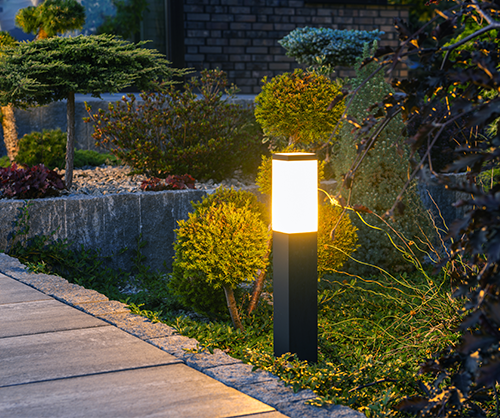
Designed to cast light downward and outward at low height (typically 18–48 inches), path lights create a safe walking corridor without glare. Spacing of 6–10 feet between fixtures is standard for most residential paths. Look for fixtures with a full cutoff design — shielded so the LED source is not directly visible — to avoid glare that reduces visibility rather than improving it.
Spike-mounted spotlights push directly into soil and are the most flexible accent lighting option — easily repositioned as plants grow and seasons change. In-ground uplights (flush with the soil or paving) provide a cleaner look but require more installation effort and a minimum IP67 rating due to water pooling risk. Both are ideal for uplighting specimen plants, trees, and architectural features.
Mounted on exterior walls, these fixtures serve both functional and decorative roles at entrances, gates, and along garden walls. Choose a style that complements your property's architecture. For functional wall lighting, a downward-facing half-lantern or bulkhead light minimizes upward light spill (light pollution) while effectively illuminating the area below.
Recessed into decking boards, steps, or retaining walls, these fixtures provide safety-focused low-level illumination. They typically require IP67 protection as foot traffic and water runoff are constant concerns. Low-profile designs with diffused lenses avoid glare and hotspots. Very low wattage (1–3W per fixture) is typical and appropriate — these lights supplement rather than replace other ambient lighting.
Wall- or pole-mounted floodlights cover large areas and are typically paired with passive infrared (PIR) motion sensors. When selecting a security floodlight, pay attention to the PIR detection range and angle — most cover a 120–180° arc at 8–12 meters. For effective security lighting, position fixtures high enough (8–12 feet) to prevent easy tampering and angle them to illuminate the ground plane rather than creating glare for approaching visitors.
Primarily decorative, LED festoon and string lights add warmth and ambiance to entertaining areas. Modern LED versions consume 80–90% less energy than filament bulb equivalents while producing the same warm glow. For outdoor permanent installation, confirm that the cable and bulb holders carry at least an IP44 rating; for exposed all-weather use, IP65 is preferable.
The power supply method has a major impact on installation complexity, reliability, running costs, and flexibility. There is no universally "best" option — it depends on your garden layout, existing electrical infrastructure, and performance expectations.
Direct mains connection provides the most reliable, consistent performance regardless of weather or season. Brightness never degrades, and fixtures can run for any duration. The tradeoff is installation complexity — outdoor wiring must use armored cable buried at the correct depth (typically at least 450mm in the UK and 300mm in the US for residential) and must be installed by a qualified electrician in most jurisdictions. Best for permanent, high-performance schemes where reliability is paramount.
Low-voltage garden lighting systems use a mains-connected transformer to step voltage down to a safe 12V or 24V DC output. This allows homeowners in many regions to install the fixtures themselves (the low-voltage cable side is generally DIY-friendly) while the transformer connects to mains by an electrician. The maximum cable run from a transformer is typically 30–50 meters depending on transformer wattage and cable gauge. Excellent for path lighting, spotlighting, and deck lights.
Solar garden lights require no wiring and are the easiest to install, but they come with significant performance caveats. Output depends entirely on solar panel quality, battery capacity, and sunlight hours. In practice, most budget solar path lights deliver 4–8 hours of useful light after a full day of sun — and significantly less in winter or overcast conditions. Solar is well-suited for casual pathway marking, decorative applications, and locations where wiring is impractical. It is not reliable for security lighting or any application requiring consistent, controllable brightness.
When evaluating solar lights, prioritize panel size (larger panels charge faster), battery capacity in Wh (watt-hours, not just mAh), and whether the fixture uses a quality lithium-ion battery rather than NiMH cells — lithium holds a better charge in cold temperatures.
Rechargeable battery-powered fixtures offer the flexibility of solar without weather dependency. They are useful for temporary installations, rental properties, or areas where neither wiring nor adequate sunlight is available. The limitation is run time — most rechargeable battery fixtures deliver 8–20 hours per charge — and the ongoing task of recharging units manually.
One of the advantages of LED technology is its compatibility with a wide range of control systems. Adding smart controls to your garden lighting dramatically improves both convenience and energy efficiency.
Garden lighting is exposed to UV radiation, temperature cycling, moisture, insects, and physical contact. Build quality directly determines how long a fixture will perform before fading, cracking, or failing.
The LED driver (the electronic component that regulates power to the LED chip) is frequently the first component to fail in low-quality outdoor lights. A quality constant-current driver maintains stable brightness and protects against voltage fluctuations. Look for fixtures that specify a driver lifespan of 30,000 hours or more, and check whether the driver is replaceable — some premium fixtures allow driver replacement, extending the fixture's usable life significantly.
Color Rendering Index (CRI) is another quality indicator often overlooked. CRI measures how accurately a light source renders colors compared to natural daylight, on a scale of 0–100. For garden lighting where you want to appreciate the true colors of foliage, flowers, and materials, choose fixtures with a CRI of 80 or higher. CRI 90+ is ideal for high-quality accent and feature lighting.
Responsible garden lighting considers its impact beyond the property boundary. Poorly designed or poorly aimed outdoor lighting contributes to sky glow, disrupts nocturnal wildlife, and can cause nuisance to neighbors. As LED adoption has grown, so has total outdoor light output — making thoughtful design increasingly important.
Putting all of the above specifications into a coherent plan requires a systematic approach. Here is a practical process to follow before purchasing any fixtures:
A well-planned LED garden lighting scheme, built around the correct specifications for each application, will deliver reliable performance for 10–20 years with minimal maintenance — making the upfront investment in quality fixtures and careful planning well worthwhile.
Related Products
 Private Industrial Park, Liangnong Town, Yuyao City, Ningbo City, Zhejiang Province, China
 +86-13486062091
 +86-574-2222 2345
 +86-574-2267 2345
 info@ym-lighting.com


 English
 中文简体
中文简体